
40 Things to Do in Tokyo on Your First Trip

There are so many things to do in Tokyo that deciding what to leave out of your itinerary is considerably harder than finding things to fill it with.
Before our first trip to Tokyo, I had a very long list. Temples, observation decks, immersive art, arcades, sumo, ramen, shopping, street karting and, apparently, renting a Japanese grandma for the afternoon.
Normal holiday stuff.
Having now been, the biggest thing I’d recommend when planning what to do in Tokyo is grouping everything geographically.
Tokyo is huge.
Shibuya Crossing and Senso-ji Temple might both be in Tokyo, but that doesn’t mean visiting one immediately after the other makes any sense.
We tried to group our sightseeing by neighbourhood during our trip and it made getting around considerably easier.
So rather than giving you a completely random list of Tokyo attractions, I’ve grouped these by area wherever possible.
This post may contain affiliate links which means that I may earn a small commission, at no extra cost to you, for qualifying purchases. For more information, read our disclaimer.
Things to do in Asakusa
Nearest station: Asakusa Station
Asakusa is where I’d start if you want to experience a more traditional side of Tokyo before throwing yourself into the skyscrapers, arcades and giant digital cats elsewhere.
It’s also an easy area to spend half a day without constantly getting back on the Metro.
1. Visit Senso-ji Temple
Senso-ji is one of Tokyo’s best-known temples and somewhere I’d absolutely include on a first visit.
Just don’t expect to have it to yourself.

We visited during July and it was packed. Arriving early will give you a slightly calmer experience, but this is one of Tokyo’s major attractions. Other people have, unfortunately, also heard of it.
Enter through the enormous Kaminarimon Gate before making your way towards the main temple.
While you’re there, make sure you draw an omikuji, a Japanese paper fortune.


You pay ¥100, shake a metal hexagonal container until a numbered stick falls out, find the corresponding drawer and retrieve your fortune.
If yours predicts terrible things, you’ll find somewhere at the temple to tie it up and leave the bad luck behind.
Which seems preferable to taking it home.
2. Eat your way along Nakamise Shopping Street
Don’t visit Senso-ji and immediately leave.
Nakamise Shopping Street leads towards the temple and is lined with stalls selling Japanese snacks and souvenirs.
Rather than having a proper lunch, we shared whatever vegetarian things I spotted as we went. This resulted in rather a lot of sweet food, but there was more variety than I expected.
And please try the pickled cucumber.
Japanese cucumbers are so crisp and flavoursome that they became a slightly unexpected highlight of my trip. They’re served chilled and lightly pickled and when Tokyo is approximately the temperature of the sun in July, they’re incredibly refreshing.
3. Find the free Asakusa observation deck
One of my favourite little finds in Asakusa was the observation deck at the Asakusa Culture Tourist Information Center.
It’s on the eighth floor directly opposite Kaminarimon Gate and completely free.

The view is slightly obstructed and it does get busy. You won’t get the enormous panoramic views of Tokyo’s paid observation decks, but you get a great view down Nakamise Shopping Street towards Senso-ji.
More importantly if you’re visiting in July, you get to step into air conditioning inside the building, which is always a win.
4. Try a kimono tea ceremony
If you want to do more than visit the temple, you could combine your time in Asakusa with a kimono tea ceremony.
We didn’t do this particular experience, so I can’t personally review it, but it’s something I’d consider if you want to learn more about Japanese tea ceremony while already spending time in one of Tokyo’s more traditional neighbourhoods.
I’m not a tea aficionado but there was a complimentary tea ceremony at our hotel which Jass experienced.
I’d much rather add an experience like this to an Asakusa day than randomly cross Tokyo for one later.
5. Watch sumo wrestling
If you’re lucky enough to be visiting during a professional sumo tournament, you could look into getting tickets to see the real thing.
If you’re not, a sumo experience at Asakusa Sumo Club is another option.


We went to a sumo show and dinner during our trip, which gave us the opportunity to learn more about the sport and see demonstrations without our dates needing to coincide with a tournament.
There was audience participation, comedy and a bottomless dinner, which happened to be delicious. We had such a great evening, I’d highly recommend booking this experience.
Duration: 2 hours
Time: Various times throughout the day
Booking: Advance booking strongly recommended
Highlights: Learn the rules of sumo, eat a traditional wrestler’s hotpot dinner, watch live demonstrations, chance to get in the ring and try out the sport for yourself, meet a geisha
Rating: 4.7 stars (check 900+ reviews here)
Price: Check price here!
Just remember that a tourist sumo experience and attending an actual professional tournament are two different things.
This ended up being one of the funniest evenings of our trip. You can read my full Asakusa sumo experience review for what the show is actually like, what we ate and whether I think it’s worth booking.
Things to do in Ueno and Akihabara
Nearest stations: Ueno Station and Akihabara Station
From Asakusa, Ueno and Akihabara are logical areas to explore next.
We skipped Ueno because it was brutally hot during our July trip and walking around an exposed park didn’t sound particularly appealing.
In milder weather, I’d have been far more tempted.
6. Explore Ueno Park
Ueno Park gives you a very different experience from nearby Akihabara.
There are museums, temples and plenty of green space, so how long you spend here really depends on what interests you.
If you’ve only got a few days in Tokyo, you don’t necessarily need to turn it into an entire day.
7. Explore Akihabara Electric Town
I’m not particularly interested in anime, manga or gaming.
And I’d still recommend seeing Akihabara once.

It’s bright, loud, busy and gloriously unsubtle.
The streets are covered in enormous signs and you’re surrounded by electronics shops, anime stores, arcades and gachapon machines.
You will see rows upon rows of people sitting at the pachinko machines, completely absorbed in the games they’re playing.
Even if you don’t understand half of what you’re looking at, that’s rather the point.


8. Play games at a Japanese arcade
You don’t need to be particularly interested in gaming to go inside one.
Japanese arcades can span several floors, with everything from claw machines to rhythm and racing games.
Have a go at something.
Or, like me, spend some time watching people who very clearly know what they’re doing.
9. Win something completely unnecessary from a gachapon machine
Once you start noticing gachapon machines in Japan, you’ll see them everywhere.
Insert your money, turn the handle and receive a tiny capsule containing an object you absolutely did not need five minutes earlier.
You will now, obviously, become emotionally invested in it.
Japan is very good at convincing you that you need small plastic things.
We won a tiny plastic souvenir that we ended up giving to a kid standing near us.
Things to do in Shibuya and Harajuku
Nearest stations: Shibuya Station and Harajuku Station
Shibuya and Harajuku work particularly well together and I’d give them the same day.
This is where you’ll find the Tokyo of enormous pedestrian crossings, shopping, youth culture and crowds.
So many crowds.

10. Walk across Shibuya Scramble Crossing
Yes, it’s touristy.
Yes, technically it’s just a pedestrian crossing.
And yes, you should probably walk across it anyway.
Part of the fun is simply standing there as hundreds of people start moving in every direction when the lights change.
I enjoyed Shibuya much more as somewhere to explore than somewhere to stay, but it’s absolutely worth experiencing.

11. See Shibuya Crossing from above
Walking across Shibuya Crossing is one thing.
Watching it from above is much better.

We went to Shibuya Sky, which gives you panoramic views across Tokyo as well as looking down towards the crossing.
This is one I’d definitely book in advance, particularly if you want to visit around sunset.

Duration: Spend as long as you want inside
Time: Various times throughout the day
Booking: Advance booking strongly recommended
Highlights: 360-degree panoramic view of the Shibuya Crossing, the iconic outdoor escalator ride & distant views of Mount Fuji on clear days
Rating: 4.7 stars (check 45,000+ reviews here)
Price: Varies depending on the time of day. Check prices here!
If you’re looking for things to do in Tokyo for couples, I’d definitely put Shibuya Sky on the list. Book a sunset slot if you can and you’ll get to watch Tokyo light up as it gets dark.

There are also free places around Shibuya where you can look down over the crossing if you don’t want to pay for another observation deck. The Shibuya Hikarie building has a Sky Lobby on the 11th floor, while the Shibuya Mark City pedestrian walkway also has free views of the crossing.
Which is probably the best way to enjoy it without actually having to stand in it.
12. Visit the Hachiko Statue
You’ll find Hachiko outside Shibuya Station.
The dog statue commemorates the famously loyal Akita who continued returning to the station waiting for his owner after his death.
You don’t need to allocate a huge amount of time to this.
If you’re already visiting Shibuya Crossing, you’re right there.
13. Get lost in MEGA Don Quijote
Don Quijote is difficult to explain until you’ve been inside one.
Snacks. Cosmetics. Electronics. Souvenirs. Household products. Luggage. Things you absolutely did not intend to buy.
The Shibuya MEGA Don Quijote is enormous and a good place to pick up Japanese snacks and souvenirs.
Give yourself a budget – and carry your passport if you intend to take advantage of tax-free shopping.
Whether you subsequently respect that budget is between you and Don Quijote.
14. Shop at Standard Products
If you like Daiso but want something that feels considerably more grown-up, look out for Standard Products, an upscale brand launched by Daiso.
Walking around the store actually reminded me much more of Muji. It has the same clean, neutral and minimalist feel, with shelves full of storage organisers, tableware, incense and homeware.
Except it’s considerably cheaper.
We visited the store in Shibuya, which is conveniently joined to Daiso. I could have bought half of it.
This is another dangerous one if you’re already wondering how you’re going to fit everything you’ve bought in Japan into your suitcase.
If you like Muji’s aesthetic but Daiso’s prices, definitely check it out.
15. Visit Meiji Jingu
From Shibuya, continue towards Harajuku and Meiji Jingu shrine.

The walk towards the shrine takes you through a huge wooded area that feels remarkably removed from the city outside.
We visited during summer, so the shade was particularly welcome.
If you’ve just come from the crowds and enormous screens around Shibuya, the contrast is quite impressive.
16. Walk down Takeshita Street
Then come straight back out into the chaos.

Takeshita Street is one of Harajuku’s best-known shopping streets, packed with fashion, sweets, cafés and shops.
It’s crowded and touristy, but if you’re visiting Harajuku for the first time, I’d still walk through it.
Just don’t assume Takeshita Street is all there is to Harajuku.

Things to do in Shinjuku
Nearest station: Shinjuku Station
I’d save Shinjuku for later in the day.
Visit the gardens while it’s light, head somewhere high around sunset and then explore once all the neon signs come on.

17. Visit Shinjuku Gyoen National Garden
Shinjuku Gyoen gives you somewhere to escape the sensory overload of the surrounding neighbourhood.
There are Japanese, English and French-style gardens spread across a huge area.
This wasn’t something I wanted to prioritise during our extremely hot July visit, but in spring or autumn I’d be much more tempted.
18. See Tokyo for free from the Metropolitan Government Building
You don’t have to pay every time you want to see Tokyo from above.
The Tokyo Metropolitan Government Building has free observation decks where you can look out across the city.
Personally, I’d pay for one observation deck that you really want to experience and then take advantage of some of Tokyo’s free views elsewhere.
19. Watch the free Tokyo Night & Light show
Stay around the Tokyo Metropolitan Government Building after dark and you can also see the Tokyo Night & Light projection show.
The building itself becomes an enormous backdrop for the projections.
It’s free, so if you’re already exploring Shinjuku that evening, this is an easy addition rather than something I’d travel across Tokyo specifically to see.
20. Explore Shinjuku at night
Shinjuku is somewhere I’d deliberately see after dark.

This is when Kabukicho, the enormous billboards and neon signs really come alive.
Look out for Godzilla Head peering over Hotel Gracery and the enormous 3D cat billboard near Shinjuku Station.
Neither needs an itinerary slot of its own.
They’re just part of wandering around Shinjuku.
And there’s a reasonable chance you’ll get lost in Shinjuku Station at some point anyway.
I truly believe this is part of the Tokyo experience.

21. Walk through Omoide Yokocho
Omoide Yokocho is a collection of tiny restaurants and bars squeezed into narrow alleyways beside Shinjuku Station.
It’s also commonly called Piss Alley in English.

Which doesn’t exactly scream come here for dinner, but there we are.
Visit in the evening when the lanterns are lit.
We found many of the tiny restaurants heavily focused on yakitori and other grilled meat, so as a vegetarian I wouldn’t personally plan dinner around it.

But it’s absolutely worth walking through.
22. Join an izakaya tour
If the idea of squeezing into a tiny Japanese bar and trying to work out what you’re ordering is slightly intimidating, an izakaya tour is an option.
We didn’t do one, so I can’t personally recommend a particular tour.
But if Japanese nightlife is high on your list, Shinjuku is one of the areas I’d consider doing one.
Things to do in Ginza and central Tokyo
Nearest stations: Ginza Station and Tokyo Station
Ginza is considerably more polished than Shinjuku and Shibuya.
Come here for shopping, food and some slightly more unusual Tokyo attractions.

23. Go shopping in Ginza
Ginza is Tokyo’s famous luxury shopping district.
You don’t need a luxury shopping budget.
We certainly didn’t have one.

You’ll find enormous department stores and flagship shops alongside more affordable Japanese brands such as Uniqlo, and it’s worth exploring even if your credit card remains safely inside your bag.
RecommendedBest Travel Insurance Plans
Travel safely with comprehensive medical coverage abroad.
If you’ve been lusting after the Onitsuka Tiger trainers that have been hugely popular on social media, Ginza is the place to buy them.
The Orange Concept store in Ginza offers free custom embroidery on Mexico 66s. However, you must join a queue at 8am before the store opens and be one of the first 100 people in line to benefit from this.
Naturally, I just purchased my trainers without customising them.
24. Shop at Daiso
At the opposite end of the shopping spectrum, go to Daiso.
Daiso is Japan’s famous 100-yen shop, although not everything costs exactly ¥100 anymore.
The best way I can describe it is like wandering into an Amazon warehouse filled with things you had absolutely no intention of buying, but now desperately want.
Stationery. Kitchen gadgets. Travel accessories. Snacks. Storage. Beauty products. Tiny organisational tools for problems you didn’t realise you had until approximately 30 seconds ago.
We found some genuinely useful things in Daiso, but half the fun is simply wandering around looking at everything.
It’s also a good place to pick up inexpensive souvenirs and little travel essentials you’ve inevitably forgotten.
Go in for one thing.
Come out with twelve.
25. See the torii gates at Hie-jinja Shrine
If you want to see a tunnel of red torii gates without travelling to Kyoto, Hie-jinja is an option in central Tokyo.
I wouldn’t cross the entire city purely to photograph some gates, but if you’re already exploring this part of Tokyo, it makes much more sense.
26. Explore Tokyo Station and Marunouchi
Tokyo Station doesn’t have to be somewhere you only visit because you’re catching a train.
The restored red-brick Marunouchi building is worth seeing and the surrounding neighbourhood gives you another very different side of central Tokyo.
If your plans already bring you through Tokyo Station, spend a little time exploring rather than disappearing immediately underground.
Things to do around Tokyo Bay
We combined teamLab Planets and street karting on the same day, which worked well geographically.
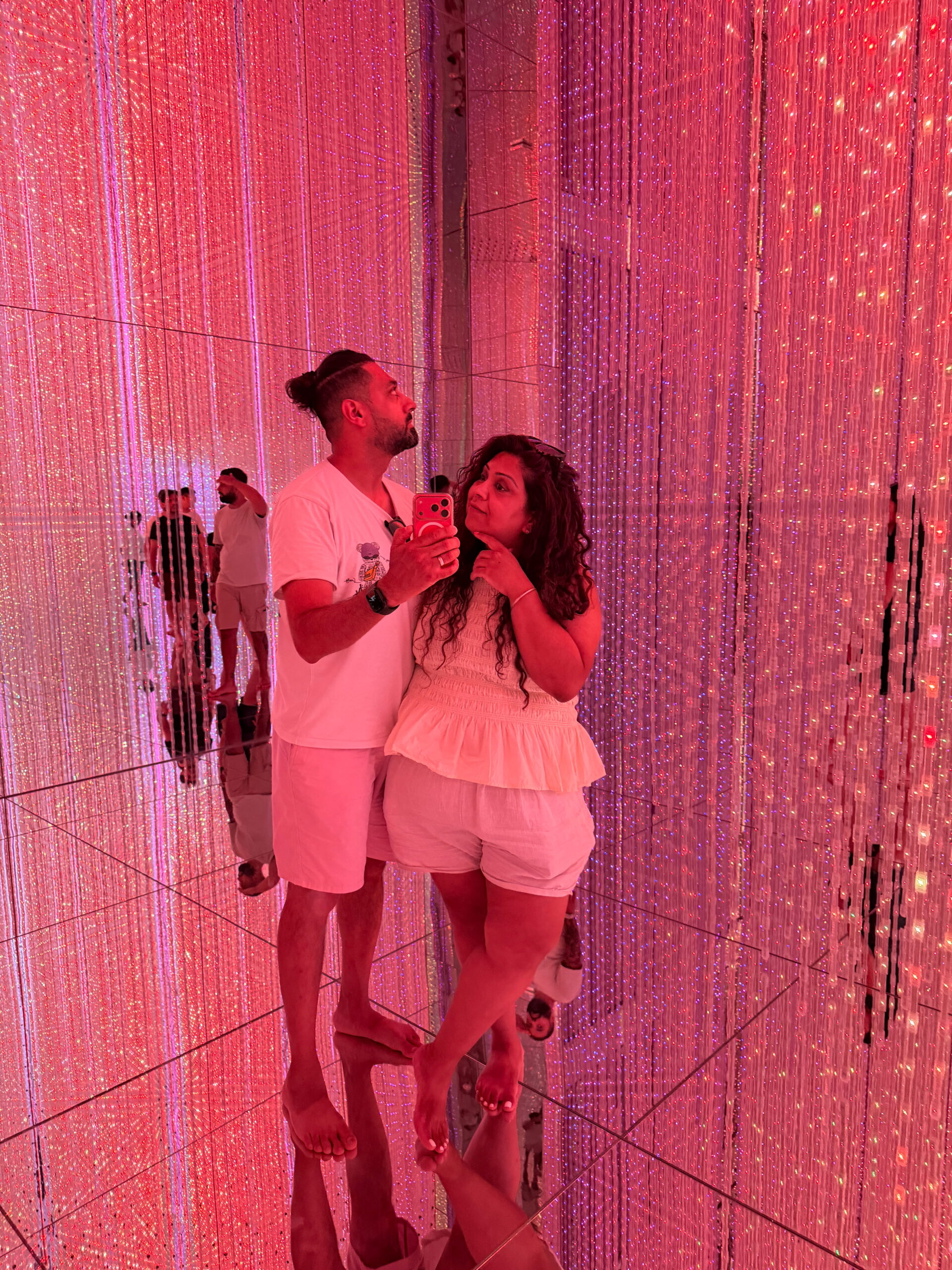
27. Experience teamLab Planets
Nearest station: Shin-Toyosu Station
teamLab Planets was one of the Tokyo attractions we booked before arriving.

This isn’t an art gallery where you politely stand in front of something with your hands behind your back.

You’re barefoot for much of the experience, moving through immersive installations and even wading through water.
It’s weird.
In a good way.
Tickets have timed entry, so I’d book this one in advance rather than assuming you’ll be able to wander in whenever you fancy.

Duration: At least 2 hours
Time: Various timed-entry slots throughout the day
Booking: Advance booking strongly recommended, particularly for weekends
Highlights: Barefoot water exhibits, immersive digital art installations, interactive forests, gardens and enormous mirrored spaces
Rating: 4.7 stars (check 21,000+ reviews here)
Price: Varies depending on your chosen date and time. Check prices here!
There is also a vegan ramen restaurant outside, which was particularly useful for me, especially because I hadn’t factored in anywhere to eat the day we had booked this.
28. Or visit teamLab Borderless
Nearest station: Kamiyacho Station
You don’t need to visit both teamLab museums on your first trip unless immersive digital art is particularly your thing.
We chose Planets.
Borderless is the alternative I’d consider depending on your itinerary and which experience appeals more.
They’re in different parts of Tokyo, so decide which one you want to visit before organising the rest of that day.
29. Go street karting around Tokyo
Nearest station: Shinkiba Station
We went street karting around Tokyo Bay.

I knew it was going to be touristy before I booked it.
I didn’t care.

Driving around Tokyo in a tiny kart like a real-life video game is objectively quite a ridiculous way to spend an afternoon.
Which is precisely why I wanted to do it.
Duration: 2 hours (3 hours including safety briefing)
Time: Various times throughout the day
Booking: Advance booking strongly recommended
Highlights: Dressing up in costume, driving a go-kart on real public roads past many Tokyo landmarks and excellent views of Tokyo Bay.
Rating: 4.9 stars (check 5000+ reviews here)
Price: Check price here!
You will need to meet the relevant driving licence requirements, so this is something to organise before arriving in Japan rather than discovering at the kart office that you’re not allowed to drive.
We did this during our trip and it was every bit as ridiculous as it looks. You can read my full Street Kart Tokyo Bay review for what it’s actually like driving through Tokyo traffic.
Things to do in Ikebukuro
Nearest station: Ikebukuro Station
Ikebukuro doesn’t fit as naturally into a short first-time itinerary, so I’d add it if gaming and anime are particularly important to you.
30. Explore the arcades of Ikebukuro
Ikebukuro has huge arcades, claw machines and gaming centres.
If you’re only mildly interested in arcades, Akihabara will probably be enough.
If you’re very interested in them, you may strongly disagree.
That’s fine.
You almost certainly know what you’re doing inside one considerably better than I do.
Other unique things to do in Tokyo
Some Tokyo experiences don’t fit neatly into a geographical itinerary.
For these, I’d choose the activity first and then see what else you can sensibly combine with it.
31. Rent a Japanese grandma
Yes.
This is a thing we did.

We booked two hours with a Japanese grandma and cooked together, and it was one of the more unusual but wholesome experiences from our trip.
It gave us something completely different from visiting another shrine, observation deck or shopping district.
I have written a separate post about this experience because “we rented a grandma” requires considerably more explanation than I’m going to squeeze in here.
32. Eat conveyor belt sushi
This would have been high on my list of things to do in Tokyo.
Sadly, as a vegetarian, the few conveyor belt sushi restaurants we came across didn’t have enough I could eat to make it worthwhile.
If you eat fish, don’t miss out on the experience.
If you’re vegetarian, don’t assume that because a restaurant serves rice and vegetables there will automatically be loads for you.
33. Eat as much ramen as possible
Obviously.
I had considerably better luck finding vegetarian ramen than sushi in Tokyo.

And you don’t need to spend months researching the city’s most famous bowl of ramen either.
Sometimes you just need dinner.
And every bowl of ramen I ate in Tokyo was outstanding.
34. Try Japanese konbini food
7-Eleven, FamilyMart and Lawson will become strangely important parts of your holiday.
Japanese convenience stores, konbini, sell proper meals, snacks, drinks and a remarkable number of things you didn’t know you needed.
Try things.
That’s half the fun.


Although as a vegetarian, I learnt fairly quickly that seemingly innocent Japanese snacks can contain fish ingredients, so check rather than assuming.
I also learned that each store sells different things, so I often found something ‘new to me’ that I could eat!
35. Go on a Tokyo food tour
If food is a major reason you’re visiting Japan, a food tour could be particularly useful near the beginning of your trip.
I’d choose one based on an area you’re already planning to explore rather than crossing Tokyo purely for the tour. This food tour in Shinjuku is very highly rated, but there are other areas you can also choose from.
And if you have dietary requirements, check exactly how they’re accommodated before paying. I found a vegan ramen tour in Shibuya which sounds incredible.
36. Watch a Japanese baseball game
This stubbornly remained on my list.
If your trip coincides with baseball season, watching a game would give you something completely different from Tokyo’s temples and sightseeing attractions.
I’d particularly consider this if you’ve got longer than five days and want to experience something beyond the standard first-time tourist circuit.
37. Spend a day at Tokyo Disneyland or DisneySea
If you’re a Disney fan, give it a day.
A whole one.
Don’t try to wedge DisneySea between Senso-ji and Shibuya Crossing because you technically found a gap in your itinerary.
DisneySea is the park I’d personally prioritise because it’s unique to Japan, but either park is going to take a substantial chunk of your Tokyo time.
38. Visit the Ghibli Museum
Studio Ghibli fans will probably already have this one firmly on their list.
The museum is in Mitaka rather than central Tokyo, so it’s another attraction I’d deliberately organise a day around rather than casually adding to whatever you’re doing in Shinjuku.
Tickets also require advance planning, so this isn’t one to leave until you arrive. They are available at 10 AM on the 10th of the month for the following month.
39. Stay in a capsule hotel
I didn’t.
And after walking around Tokyo all day, I quite liked having an actual hotel room to come back to.
But if you’re curious about capsule hotels, spending one night in one could be an experience in itself.
Personally, I wouldn’t choose one for my entire stay purely for the novelty.
We spent most of our Tokyo stay at Park Hotel Tokyo, and you can read my full Park Hotel Tokyo review if you’re looking for somewhere to base yourself.
40. Take a day trip to Hakone
If you’ve got five or more days in Tokyo, I’d seriously consider using one of them to get out of the city completely.
We took a day trip to Hakone and after several days of skyscrapers, neon signs, packed trains and what felt like millions of people, the change of scenery was very welcome.


We travelled from Shinjuku on the Romancecar and then followed the classic Hakone loop backwards, starting with the bus to Hakone-jinja Shrine.
Doing the route this way worked really well for us because we reached the shrine before it became too busy.

From there, we travelled across Lake Ashi before taking the ropeway towards Owakudani, where the volcanic landscape is a considerable change from anything you’ve seen in Tokyo.
We also ate one of Owakudani’s famous black eggs, which are said to add seven years to your life.

So presumably I can now spend those additional seven years planning another trip to Japan.
Hakone is a long day and I wouldn’t squeeze it into a very short Tokyo trip.
But if you have around five days or more, I think it’s worth sacrificing one day in the city to see a completely different side of Japan.
Which Tokyo observation deck should you visit?
Tokyo has an almost unreasonable number of places from which you can look down at Tokyo.
There’s Shibuya Sky, Tokyo Skytree, Tokyo Tower, Roppongi Hills and the free Tokyo Metropolitan Government Building, alongside smaller free viewpoints such as the Asakusa Culture Tourist Information Center.
You do not need to visit all of them.

We chose Shibuya Sky as our main paid observation deck because it fitted naturally into our Shibuya day.
That’s how I’d choose yours too.
Don’t cross Tokyo because somebody on the internet tells you one observation deck is marginally better than another.
Pick the one that works with the area you’re already exploring.
If you can, go around sunset.
Then make use of Tokyo’s free viewpoints elsewhere.

How many days do you need in Tokyo?
For a first trip, I think five days in Tokyo works really well. That’s how long I’d recommend if you want to see the main areas without rushing, and I’ve put together my complete 5 days in Tokyo itinerary showing how I’d organise them.
You won’t see everything.
That’s fine.
I’m not convinced seeing everything is a particularly sensible goal in a city this massive anyway.
Five days gives you enough time to explore several completely different areas without turning every day into a race.
It also gives you enough time to sacrifice one day for somewhere like Hakone if getting out of the city is important to you.
If you have longer, that’s when I’d start adding places like Ikebukuro, DisneySea and the Ghibli Museum rather than desperately trying to squeeze them around your main sightseeing.
Our Tokyo stay was part of a wider 10 day Japan itinerary, where we combined Tokyo with Sapporo rather than trying to cram six Japanese cities into ten days.
After five days in Tokyo, we headed north to Hokkaido, where I discovered that there are plenty of things to do in Sapporo without the same relentless pace of sightseeing.
Where should you stay in Tokyo?
Where you stay makes a bigger difference to getting through this list than you might expect.
We stayed in Shiodome, at Park Hotel Tokyo for most of our trip and I found it incredibly convenient because we had easy access to multiple train and Metro lines without having to stay somewhere as relentlessly busy as Shibuya.

We did stay in Shibuya later, at Shibuya Excel Hotel Tokyu.
I wouldn’t base myself there again.
I’ve compared the neighbourhoods and hotels I’d actually consider in my full guide to where to stay in Tokyo.
For a first trip, I’d personally choose Shiodome again.
What shouldn’t you miss in Tokyo?
If this list of 40 things has left you thinking you need another three weeks in Japan, you don’t.
For a first trip, I’d make sure you experience Asakusa and Senso-ji for traditional Tokyo, Shibuya and Harajuku for the Tokyo you’ve probably pictured before arriving and Shinjuku after dark for neon, crowds and organised chaos.
Then choose one observation deck.
Add one immersive or unusual experience, whether that’s teamLabs, a sumo experience, street karting or renting someone’s grandma.
Eat Japanese food without scheduling every meal to within an inch of its life.
And leave yourself some time to wander.
Because some of my favourite things in Tokyo weren’t the attractions I’d carefully added to an itinerary months beforehand.
They were discovering a free observation deck because we were hot, becoming weirdly enthusiastic about convenience stores and eating an unreasonable amount of cucumber.
Tokyo has more than enough famous attractions.
You don’t need to collect all of them.
Pick the things to do in Tokyo that actually interest you, group them sensibly and give yourself enough time to enjoy being there rather than spending your entire trip trying to complete Tokyo.
If you’re now trying to work out how to fit all of this into an actual trip, my 5 days in Tokyo itinerary has everything grouped geographically so you’re not travelling backwards and forwards across the city.
If you found this guide on the top things to do in Tokyo helpful, PIN IT!


Read more about planning a trip to Japan:
- 10 Days in Japan in July for First-Time Visitors
- 5 Days in Tokyo: A First-Timer’s Tokyo Itinerary
- Where to Stay in Tokyo for the Best First Time Experience
- Park Hotel Tokyo Review: Is This Art Hotel Worth Staying At?
- 40 Things to Do in Tokyo on Your First Trip
- My Asakusa Sumo Experience: Is It Worth Booking?
- Street Kart Tokyo Bay: Is It Worth Doing?
- Hakone Day Trip From Tokyo: Route, Tips & Mistakes to Avoid
- Renting a Grandma in Tokyo: What Happened When We Tried It
- Things to Do in Sapporo: 22 Places to Visit on Your First Trip
Need help planning your trip from start to finish?
Check out these helpful links:
- 👉🏼 Find cheap flights
- 👉🏼 Savings on accommodation from boutique hotels to affordable resorts
- 👉🏼 The most comprehensive resource to help plan excursions on your next trip
- 👉🏼 This pass gives you free lounge access to over 1500 airport lounges
- 👉🏼 Affordable car rental options
- 👉🏼 Book land and water transport for travelling around South East Asia
- 👉🏼 Use an eSIM to prepare your phone for international travel before leaving
- 👉🏼 Pay anywhere in the world, in any currency, using your debit card without fees
- 👉🏼 Travel insurance with essential medical & travel coverage at low premiums
Last-Minute Flight Deals
Grab incredible discounts on flights to New York, Paris, and London.
