
Hakone Day Trip From Tokyo: Route, Tips & Mistakes to Avoid


After a few days in Tokyo surrounded by skyscrapers, neon signs, packed trains and what felt like several million people, our Hakone day trip was a very welcome change of scenery.
We wanted to see somewhere outside Tokyo without changing hotels, and a day trip to Hakone seemed like the perfect way to do it.
So we booked an early Romancecar from Shinjuku and spent the day following the famous Hakone Loop.
Just backwards.
The standard route takes you around Hakone in the opposite direction, but I’d read that doing the loop anti-clockwise could potentially mean fewer crowds.
Did this cunning plan work?
Not particularly.
There seemed to be hundreds of people everywhere we went.
But the route itself worked brilliantly, taking us through mountain scenery, volcanic landscapes, Lake Ashi and several places where we theoretically could have seen Mount Fuji.
Theoretically being the important word there.
Fuji will appear when Fuji feels like it.
Sadly, it didn’t appear for us.
If you’re planning a Hakone day trip from Tokyo, this is exactly how we spent ours, including our route, how we travelled from Tokyo to Hakone and a few things I’d do differently next time.
This post may contain affiliate links which means that I may earn a small commission, at no extra cost to you, for qualifying purchases. For more information, read our disclaimer.
Is Hakone worth a day trip from Tokyo?
I think so, but I wouldn’t sacrifice a day in Tokyo if you only have two or three days in the city.
We visited Hakone as part of my 5-day Tokyo itinerary, after we’d already spent several very busy days exploring the city.
By that point, getting out into the mountains was exactly what we needed.

Hakone is known for its onsen, volcanic scenery, Lake Ashi and views of Mount Fuji when the weather decides to cooperate.
It feels completely different from central Tokyo, but it’s close enough that you can visit on a day trip from Tokyo without moving hotels or dragging your luggage across Japan.
There is one catch.
It’s a long day.
Our Hakone day trip started early and we didn’t arrive back in Shinjuku until around 9.45pm.
Hakone one day itinerary
We followed the Hakone Loop anti-clockwise, travelling from Hakone-Yumoto to Gora first and then continuing around towards Owakudani, Lake Ashi and Hakone Shrine.
Our route looked roughly like this:
Shinjuku, Tokyo → Hakone-Yumoto → Gora → Sounzan → Owakudani → Togendai → Lake Ashi → Hakone Shrine → Hakone-Yumoto → Tokyo
It sounds like a lot.
It is.
But Hakone’s transport system connects the main sights surprisingly well, and travelling between them is part of the fun.
During one day we managed to use a train, mountain railway, cable car, ropeway and pirate ship.
Because apparently one form of public transport would have been boring.
How to get from Tokyo to Hakone
There are several ways to travel from Tokyo to Hakone by train, depending on whether you prioritise speed, price or convenience.
Fastest: Take the Tokaido Shinkansen from Tokyo or Shinagawa to Odawara, then change onto a local train to Hakone-Yumoto. This is usually the quickest option, but it’s also more expensive and involves changing trains.
Cheapest: Take a regular JR train to Odawara and change for Hakone-Yumoto. You’ll save money, but the journey takes longer, so I wouldn’t personally choose this option for a day trip to Hakone when time is already limited.
Easiest: Take the Romancecar directly from Shinjuku to Hakone-Yumoto. It costs more than taking the regular Odakyu train because you pay an additional Limited Express fare, but in return you get a reserved seat, a faster journey and, most importantly, no changes.
We chose the Romancecar.
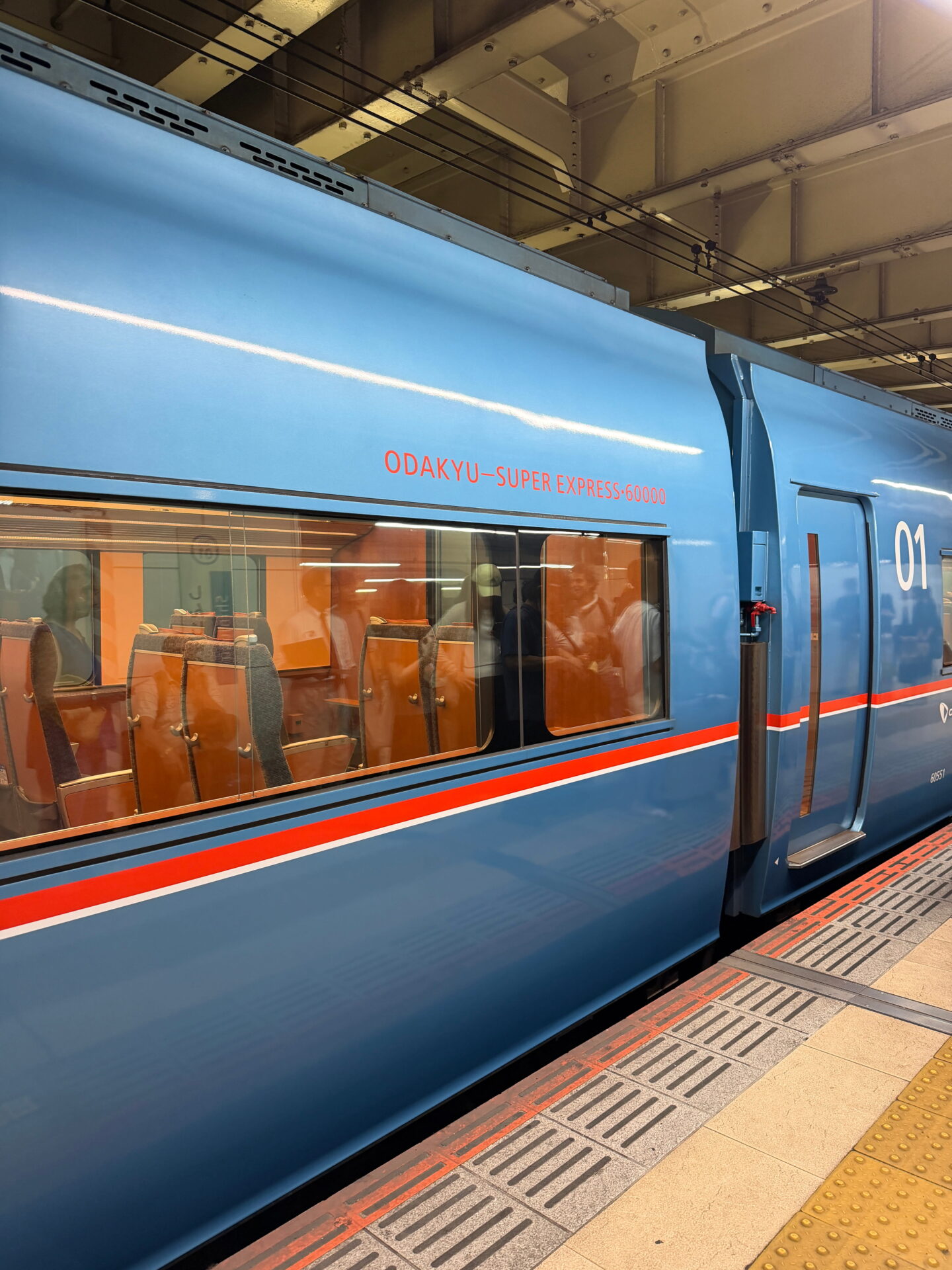
You can also travel from Shinjuku using the regular Odakyu service, but the Romancecar cuts down the journey time and removes the hassle of changing trains. For a day trip where we wanted to squeeze as much as possible into one day, paying extra for the convenience was worth it for us.
You can check the current Romancecar fare and book tickets here.
I should warn you, I thought the Romancecar would be something special given the name, but it just looks like a regular train.
There’s nothing romantic about it, ha!
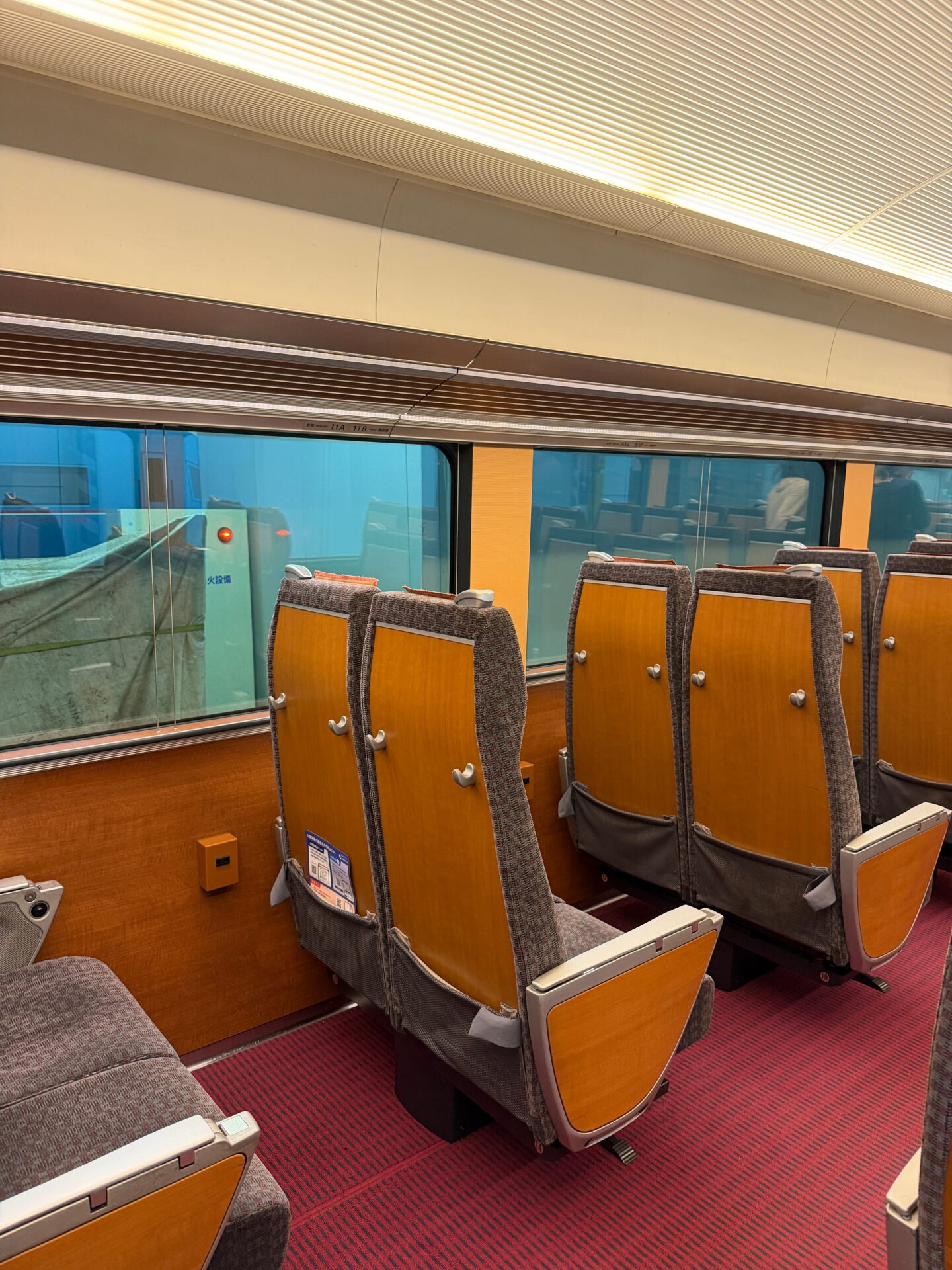
Our train left Shinjuku Station at 9.20am and we’d booked our seats in advance.
There is plenty of advice online about booking the Romancecar’s observation seats at the front or rear of certain trains. If you’re hoping to see Mount Fuji while travelling from Tokyo to Hakone, you’ll also see recommendations to choose seats C or D on the right-hand side.
We dutifully followed the advice.
However, it wasn’t a particularly clear morning, so we didn’t see Fuji at all. Our Romancecar didn’t have the observation seats I’d expected either, despite us sitting in the front carriage.
That was confusing.
Still, the journey itself was easy and relaxing.
Finding the correct place to board inside Shinjuku Station was arguably the biggest challenge.
Give yourself plenty of time at Shinjuku Station
If you’ve never experienced Shinjuku Station before, it is enormous.
And confusing.
This is not the morning to arrive five minutes before your Romancecar confidently assuming you’ll spot one enormous sign saying HAKONE THIS WAY.
We allowed around 40 minutes before departure and I was very glad we did.
We’d already booked our Romancecar tickets, but we also picked up our Hakone Freepass at Shinjuku Station before boarding.
Where to purchase the Hakone Freepass
- You can purchase the Hakone Freepass online – the option I would recommend.
- In person, you can purchase the pass from the Odakyu Sightseeing Service Centers at Shinjuku and Odawara stations, as well as from ticket vending machines.
- Directly online on the official website but it requires more steps and must be purchased on a phone.
- In Hakone, major local stations like Hakone-Yumoto and Gora also sell the area-only version of the pass directly at ticket counters and machines. However, we were told that we need the pass before passing through the barriers to board the Romancecar, so this wasn’t an option for us.
I would highly recommend you purchase the Hakone Freepass online, in advance, and redeem it at Shinjuku Station on the morning of your trip. This will save you a lot of stress on the day.
The Hakone Freepass is available for different durations, and we bought the two-day version even though we were only taking a day trip to Hakone. I’d check the current prices before travelling, as fares can change.
If you’re following the Hakone Loop, the Hakone Freepass makes getting around considerably easier because it covers the main forms of transport you’ll use once you’re there, excluding things like taxis.
It’s well worth the money and there are a surprising number of forms of transport involved.
Train. Cable car. Ropeway. Pirate ship.
It can feel as though you are constantly travelling between places if you don’t leave early enough and stop to explore in between.

Should you do the Hakone Loop clockwise or anti-clockwise?
Once you reach Hakone-Yumoto Station, you can follow the famous Hakone Loop connecting many of the area’s main attractions.
We decided to do it anti-clockwise.
From Hakone-Yumoto, we started by taking the Hakone Tozan train towards Gora rather than heading towards Lake Ashi first.
I’d hoped doing the Hakone Loop in the opposite direction to the standard route might help us avoid some of the crowds.
I’m not convinced it did.
There were people everywhere, going in both directions.
You just have to accept that this is all part of a Hakone day trip.
I wouldn’t change the route if I were planning the same Hakone one day itinerary again, but it really doesn’t make much of a difference whichever you choose.
If your main priority is visiting the Hakone Shrine, I would recommend heading there first before it gets too busy. The queue to take a photo under the shrine can be hours long, so it’s best if you follow the Hakone Loop in the clockwise direction.
We ended there, gradually making our way around the main sights before returning to Hakone-Yumoto in the evening.
Start your Hakone day trip in Gora
From Hakone-Yumoto Station, we crossed the platform and took the Hakone Tozan train to Gora.
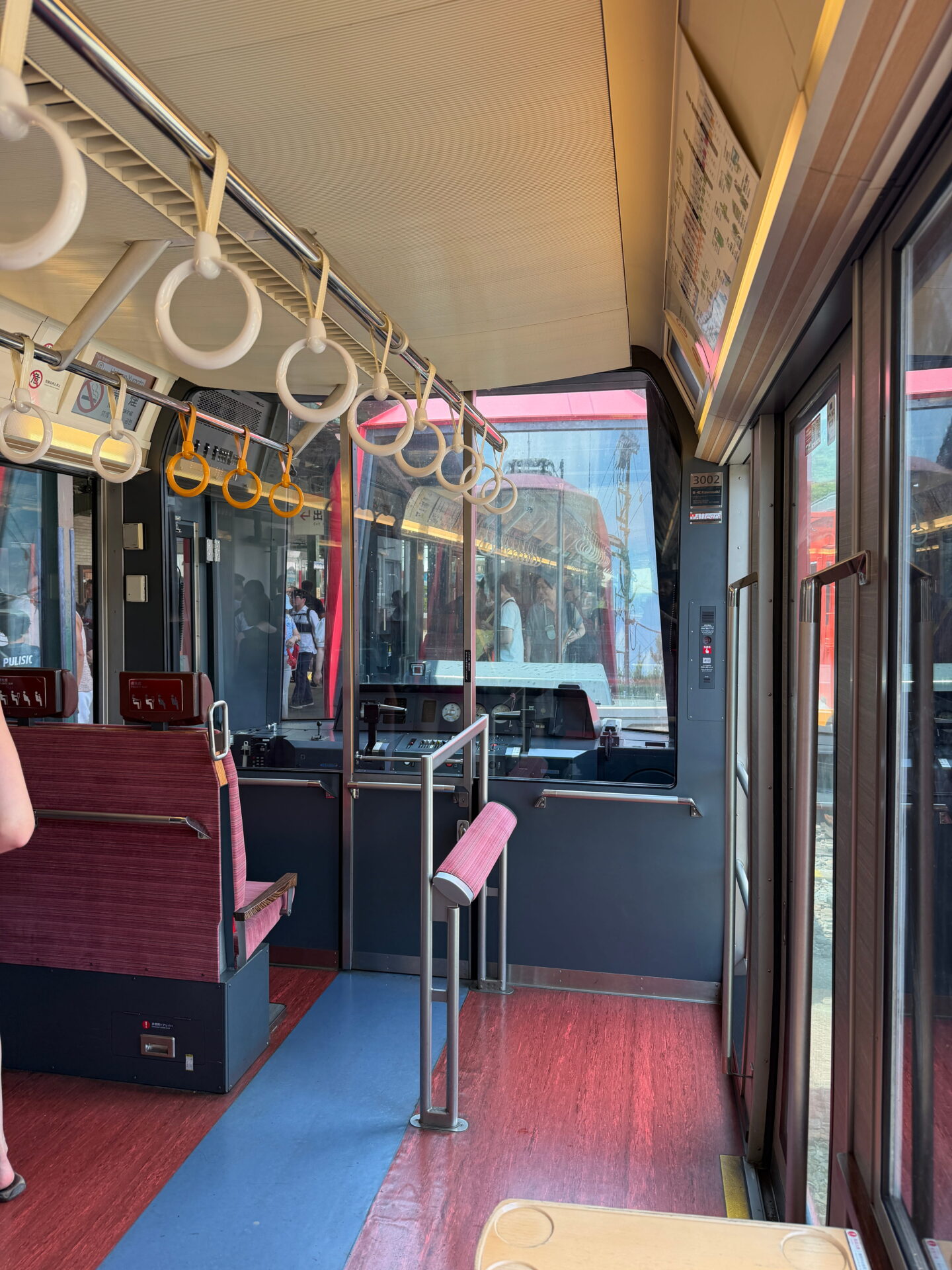
The train zig-zags its way up the mountain, changing direction as it climbs, which makes the journey interesting in itself, so it really doesn’t matter which direction you sit facing.
The driver physically got out of his seat and was running back and forth to drive the train in whichever direction it was headed next!

Once we reached Gora, our first priority was food.

We found a small vegan café and stopped for shaved ice covered with strawberry syrup, red bean paste and vegan condensed milk. I was ridiculously excited about this because, being dairy intolerant, it was the only shaved ice I managed to have during our 10 days in Japan.
It was exactly what you need during a Japanese summer.

We then headed to Gora Brewery and Grill, tempted by two things: a cold beer for Jass and the promise of a natural hot spring footbath for me.
Getting there required climbing an incredibly steep hill that could rival the incline setting on any treadmill.
The beer lived up to expectations.
The footbath did not.
It was far too hot to stand next to comfortably, never mind voluntarily put my feet into.

We later discovered that Gora Brewery and Grill collaborates with Nobuyuki Matsuhisa, which suddenly explained why the restaurant and menu looked distinctly Nobu-like.
It felt very boujie for a quick pit stop for some beer and a ginger ale!

If you’re arriving around lunchtime, this is somewhere I’d consider stopping for a proper meal.
We ordered some spicy edamame and burdock root chips to share, both of which were delightful.
I wish we had been hungry enough to have a proper meal, but it was barely midday. A decision we would later regret.
Take the Hakone Tozan Cable Car to Sounzan
Back at Gora Station, we took the Hakone Tozan Cable Car up to Sounzan.

At Sounzan, you can enjoy the footbath on the observation deck with incredible views of the Hakone mountains.
From there, you transfer onto the Hakone Ropeway towards Owakudani.

One of the things I liked most about our day trip to Hakone was that travelling between the different stops didn’t feel like wasted time.
The transport is part of the experience.
And once you’re on the ropeway, the scenery becomes considerably more dramatic.
Ride the Hakone Ropeway to Owakudani

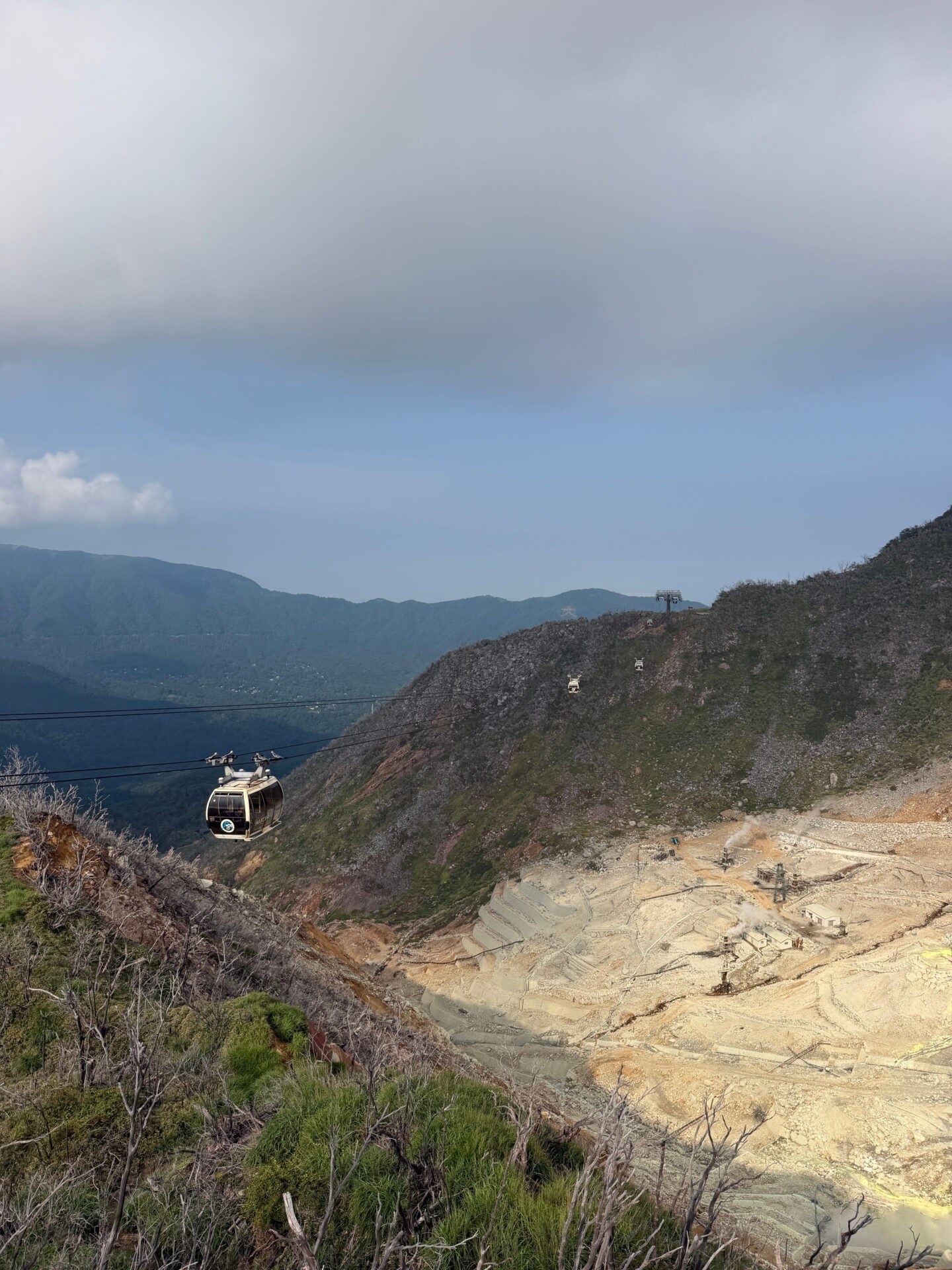
The Hakone Ropeway takes you towards Owakudani, and the scenery gets increasingly dramatic the closer you get.
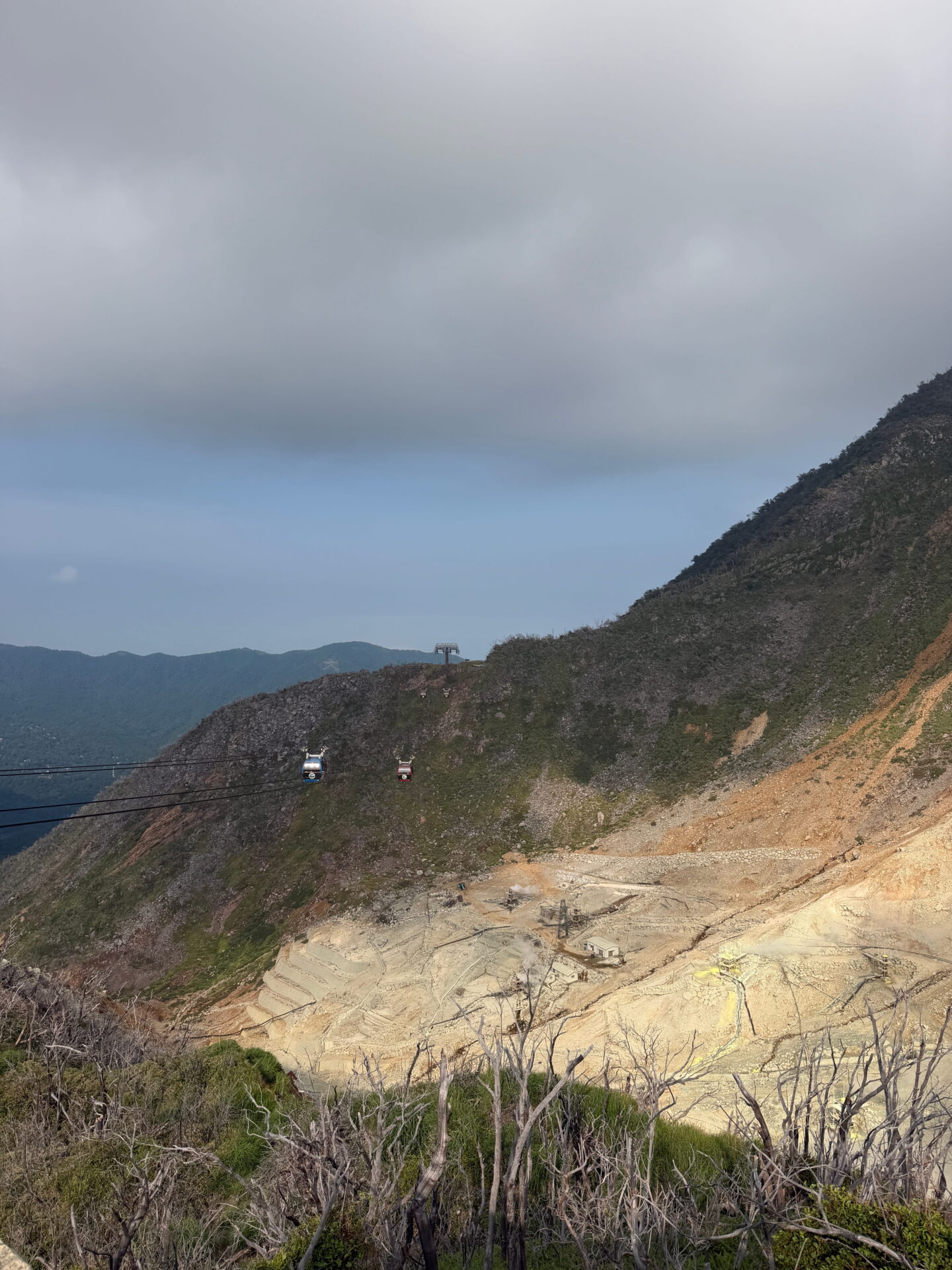
Owakudani translates to Great Boiling Valley, which feels pretty accurate once you see it. The landscape was formed following a volcanic eruption around 3,000 years ago, and today steam still rises from the ground all around you.

You can smell it too.
The sulphur hits you pretty quickly and, quite frankly, it stinks.
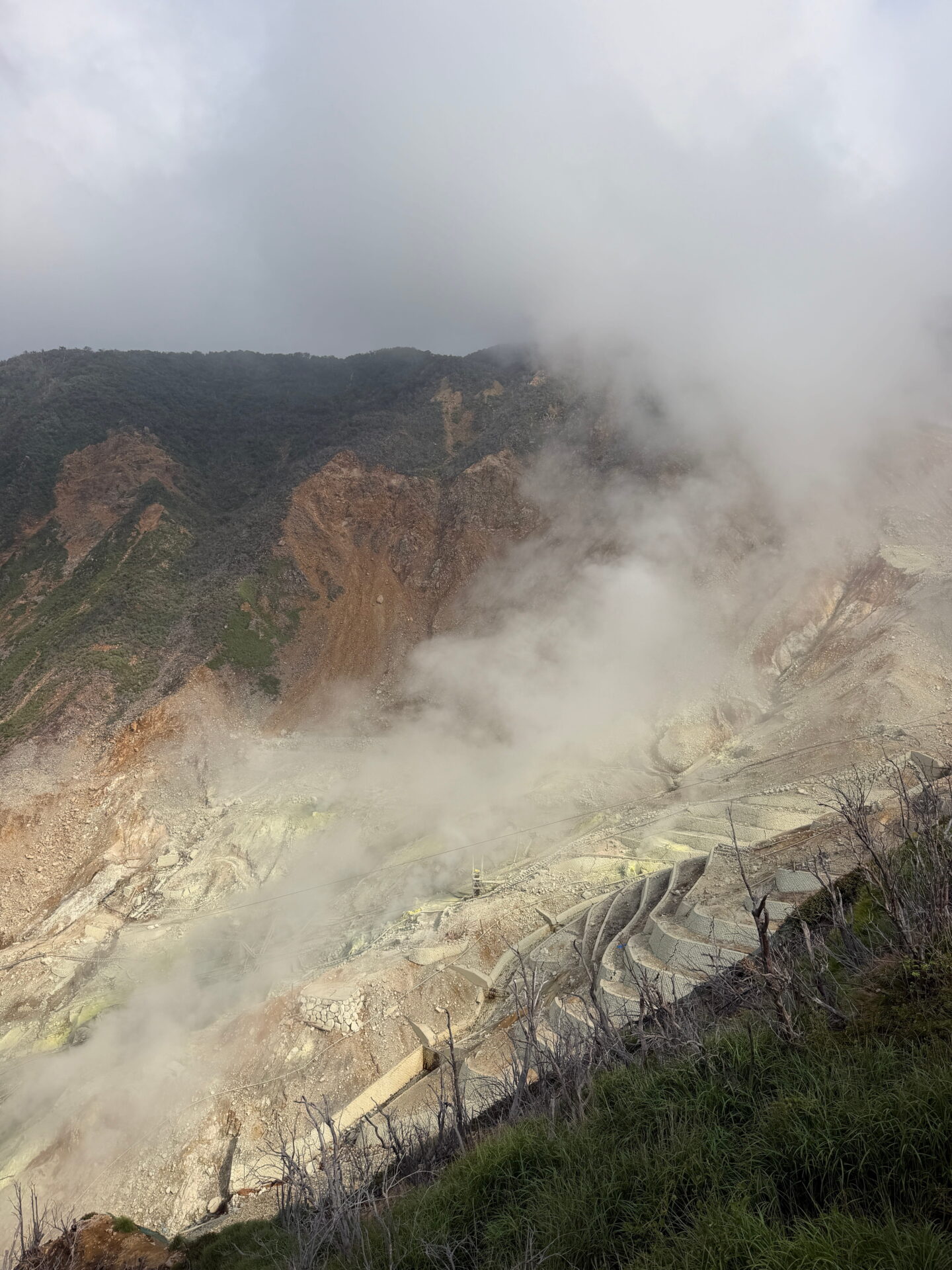
There are signs warning about the volcanic gases, while clouds of steam rising from the mountainside make it very obvious that there’s still plenty going on beneath your feet.
It was one of my favourite stops on our Hakone day trip because it felt completely different from anything we’d seen in Tokyo. One minute you’re surrounded by skyscrapers, and the next you’re standing in what looks like the aftermath of a volcanic eruption.
Japan doesn’t really do boring.
There are dramatic viewpoints around the area and if the weather is on your side, this is another opportunity to see Mount Fuji.
The weather was not on our side.
Still no Fuji.

Eat one of Owakudani’s famous black eggs
At Owakudani, you’ll see people eating black eggs, known as kuro tamago.
They’re ordinary hard-boiled eggs cooked using the area’s naturally hot volcanic water, which turns their shells black. Once peeled, it looks just like a regular hard-boiled egg.
According to local legend, eating one adds seven years to your life.
So naturally, we ate one each.
I’m not rejecting an additional seven years over an egg.

Presumably I can now spend those extra seven years planning another trip to Japan.
Once we’d finished exploring Owakudani, we got back onto the Hakone Ropeway and continued down towards Togendai and Lake Ashi.
Take the pirate ship across Lake Ashi
Yes.
Pirate ship.

At Togendai, we boarded one of Hakone’s sightseeing cruises across Lake Ashi.
For reasons I’m still not entirely clear on, the boats are designed to resemble elaborate pirate ships.
Just go with it.
The regular seating was included with our Hakone Freepass, although there was an option to pay extra to upgrade.
We didn’t bother, and to be honest, it didn’t seem worth it.

The views from the standard section were perfectly good, and travelling across Lake Ashi surrounded by mountains was one of the most relaxing parts of the day.
The lake looks beautiful when you’re sailing across it. It’s a great place to spot Mount Fuji, but you can probably guess how that went for us.
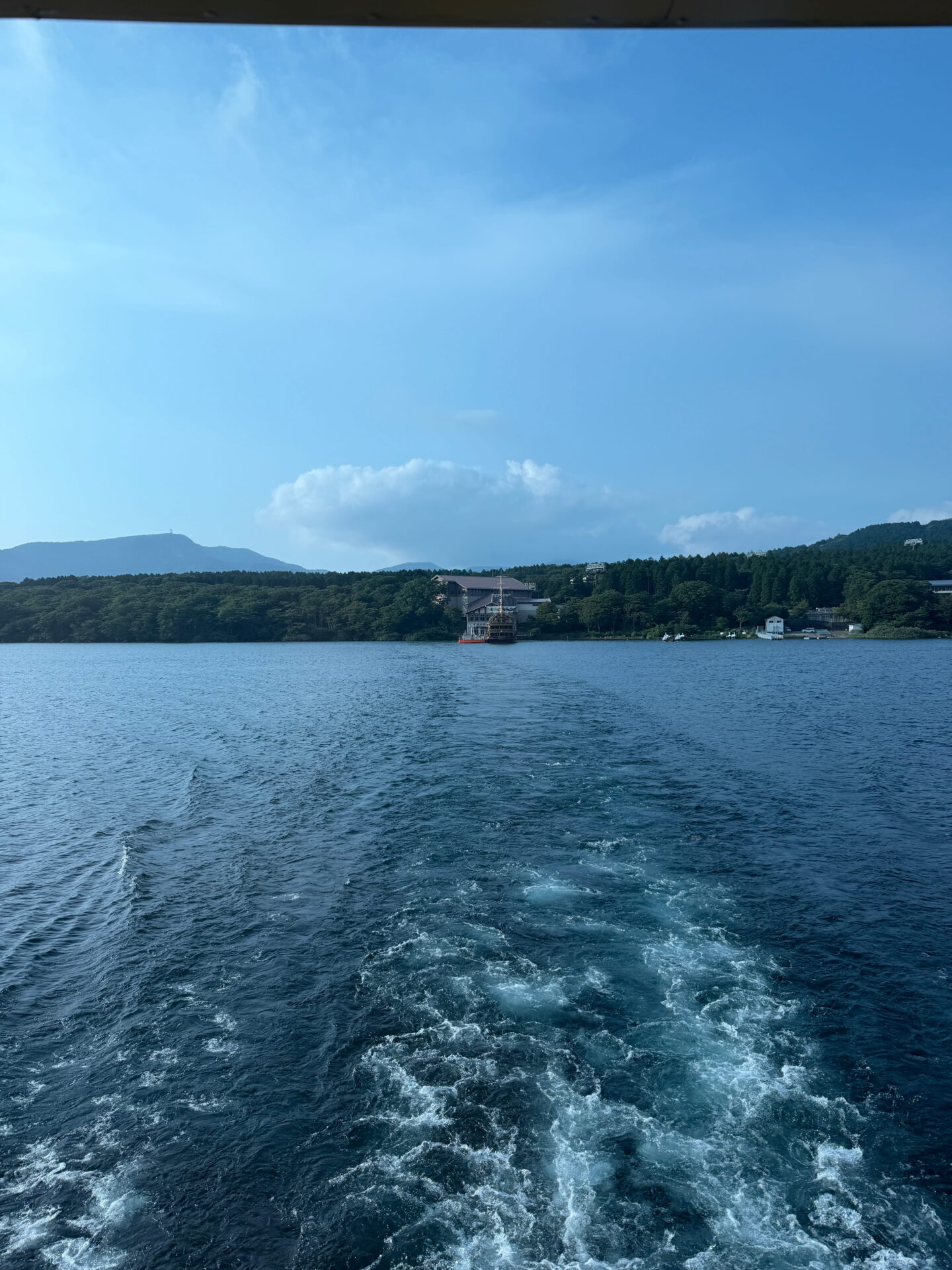
Let me just put you out of your misery and tell you now that we didn’t spot Mount Fuji on our Hakone day trip at all.
We finally caught a glimpse of it from Shibuya Sky on our last day in Japan – talk about saving the best till last!
Visit Hakone Shrine and the torii gate
After crossing Lake Ashi, we made our way towards Hakone Shrine.
Accidentally taking the longer route, we walked for around 20 minutes but this could have been halved if we’d followed the small crowd instead of Google Maps.
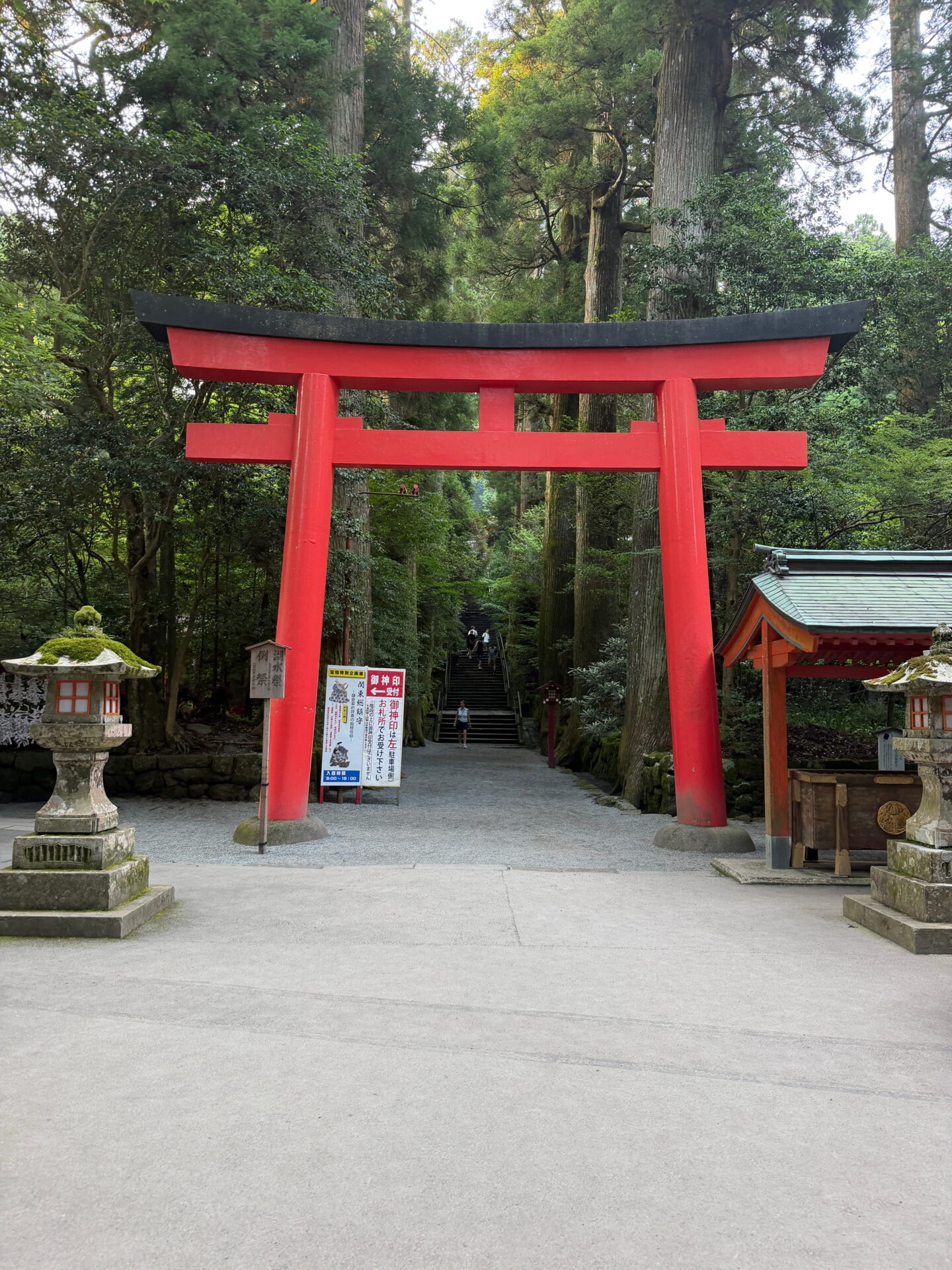
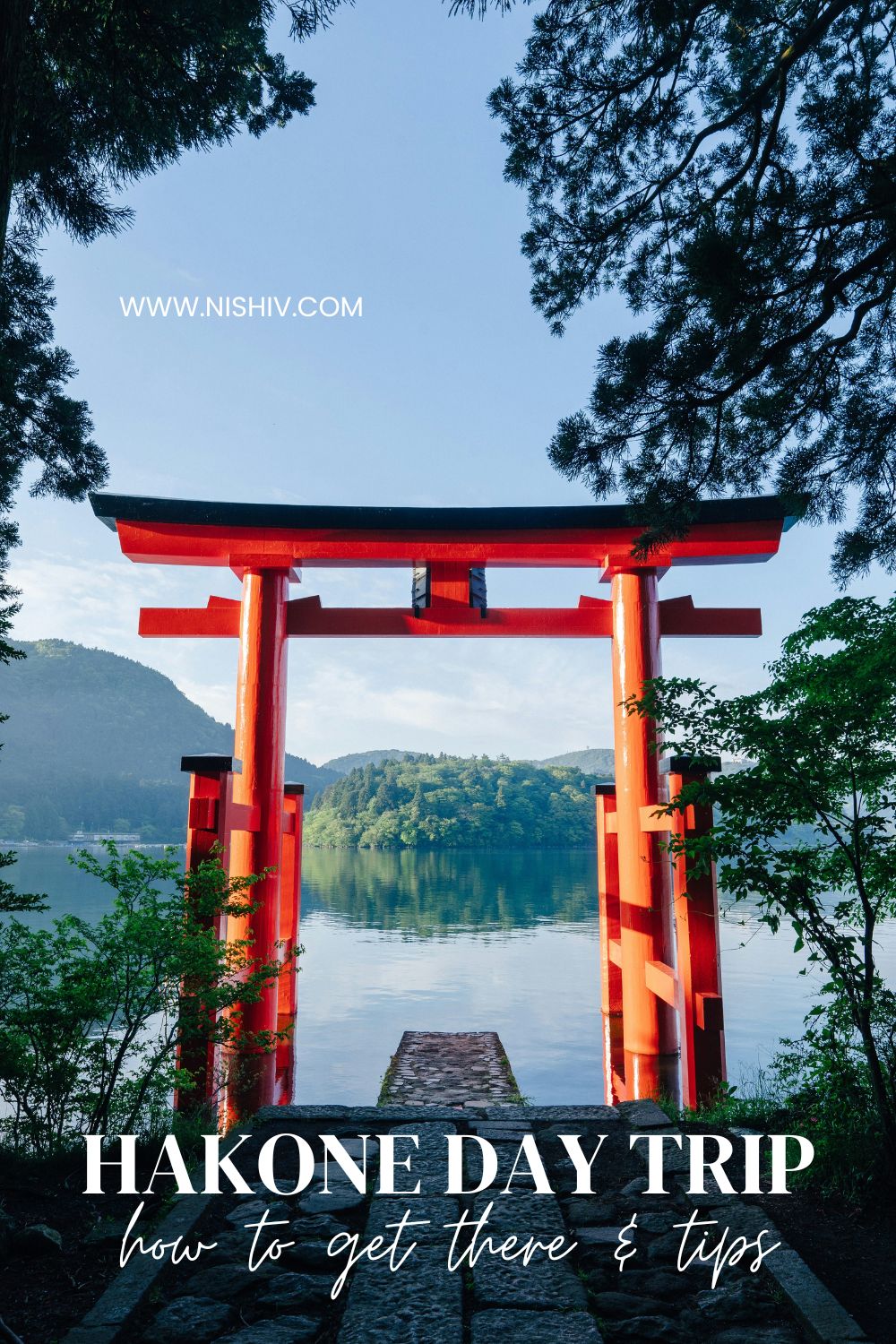
The shrine sits amongst the forest beside the lake, but its most recognisable feature is the large red torii gate standing in the water.

It’s extremely photogenic. But unfortunately everyone else knows this too.
When we visited, the queue to take a photo beneath the torii gate was around 40 minutes long.
Apparently it’s also a popular place to propose. After I shared that we’d visited, several people messaged me to say they’d got engaged there.
Very romantic.
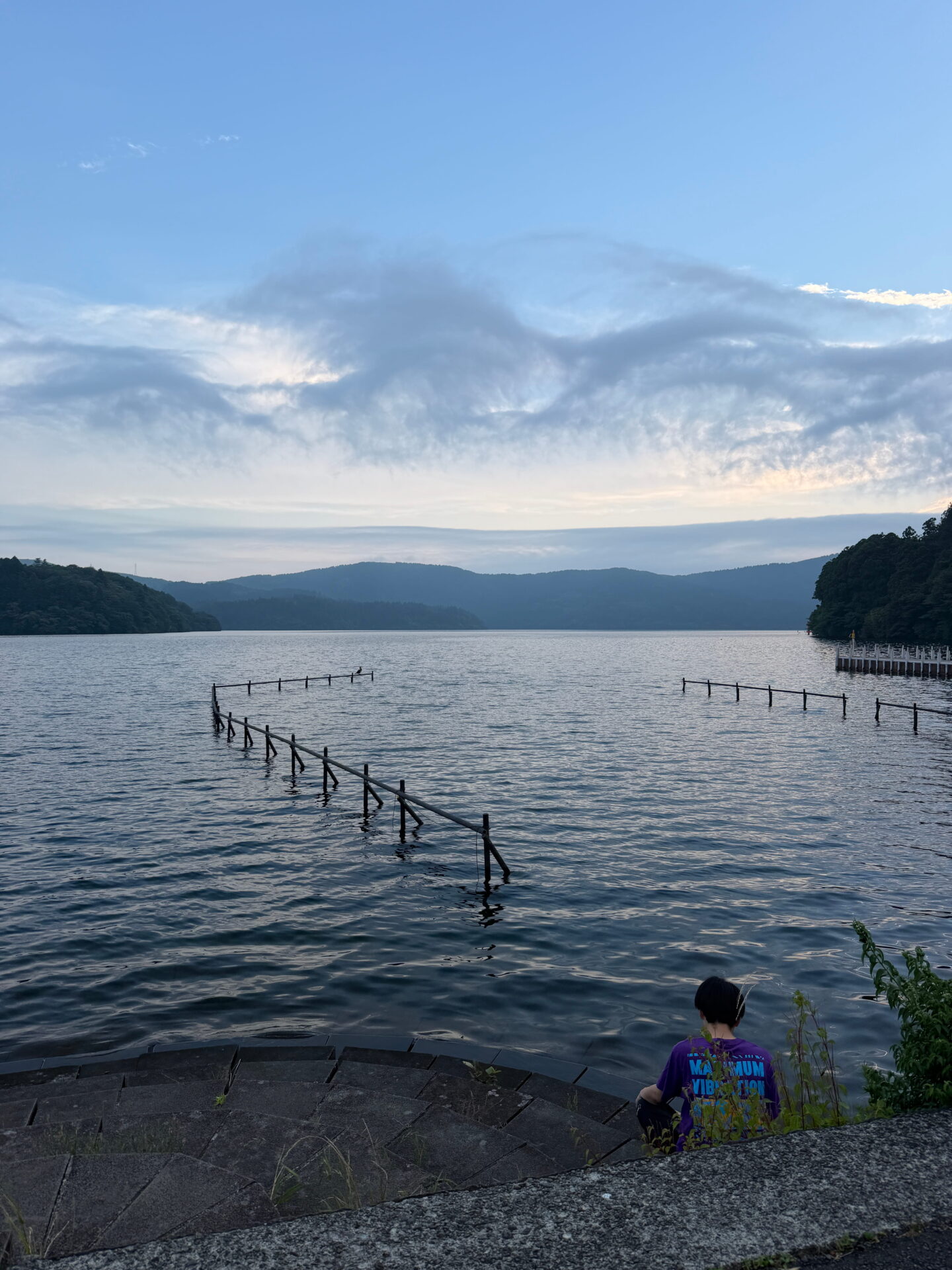
I wasn’t waiting 40 minutes for a photo op, so we explored the area instead before starting the journey back towards Hakone-Yumoto Station.
Don’t make our dinner mistake
If there’s one practical thing I’d change about our Hakone day trip, it’s this.
Eat a proper meal somewhere.
We hadn’t planned lunch or dinner because I’d assumed we’d simply find somewhere to eat towards the end of the day before catching the Romancecar back to Tokyo.
We were wrong.
Many of the restaurants we’d found around Lake Ashi had closed by 3 or 4pm and by the time we arrived back at Hakone-Yumoto Station, many of the restaurants we’d found there had already closed by 7pm.
This would have been considerably less annoying if we’d eaten a substantial lunch.
We hadn’t done that either.
We’d eaten breakfast at around 6am and survived mostly on snacks throughout the day.
By the evening, we were approaching dangerous levels of hangry.
Dinner therefore came from the 7-Eleven near Hakone-Yumoto Station.
Finding a substantial convenience-store dinner when you don’t eat meat or fish can be very challenging, but I somehow managed to find the last packet of vegetarian sushi.
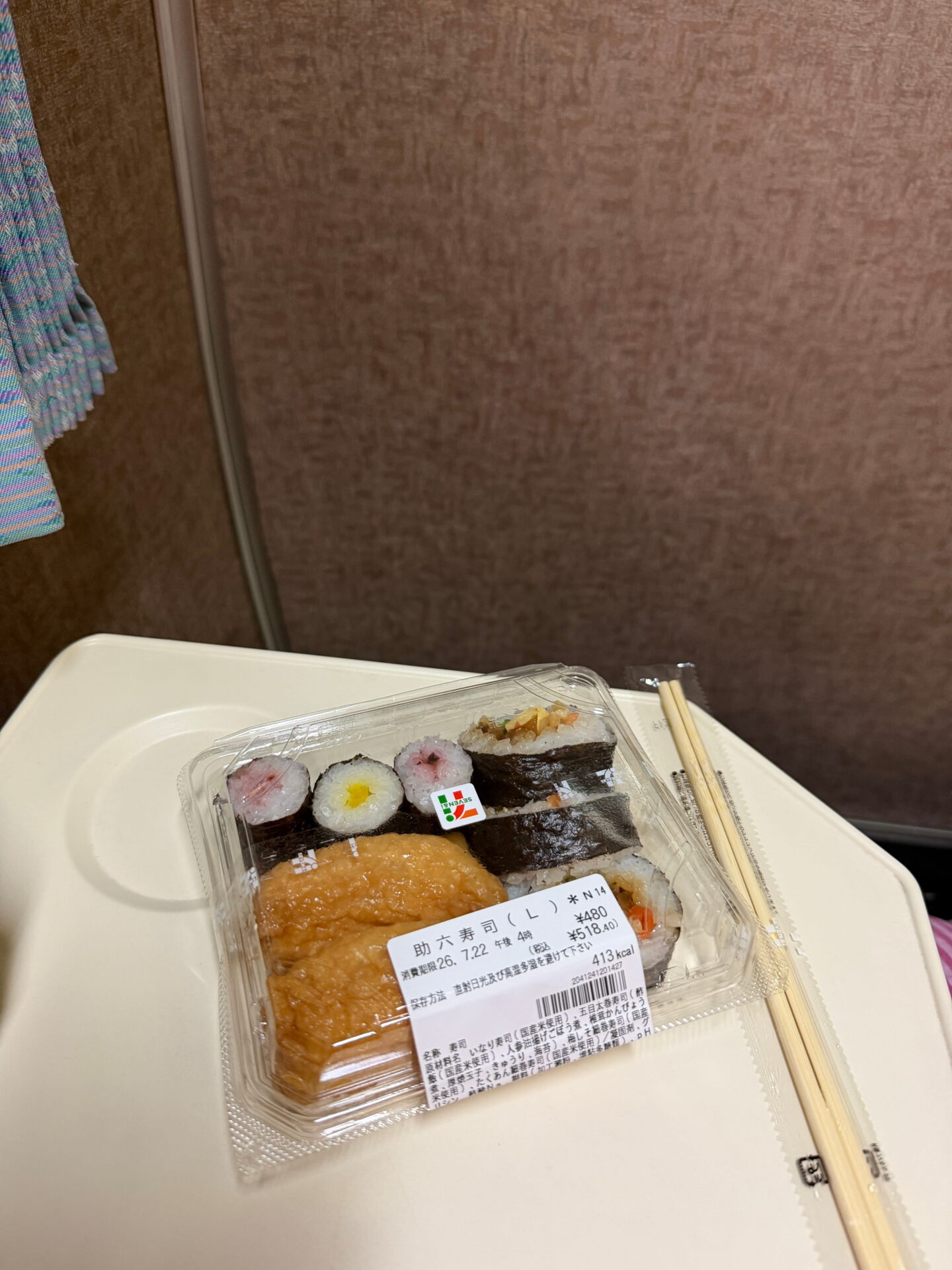
It was actually one I hadn’t seen anywhere else in Japan.
Not quite the elegant ending to our day trip to Hakone I’d imagined.
But delicious nonetheless.
If you’re following a similar Hakone one day itinerary, either stop somewhere for a proper lunch or check where you can eat before the restaurants start closing.
Preferably both.
Thankfully you are allowed to eat and drink on the Romancecar, so we did just that, arriving back at Shinjuku Station around 10pm.
How long do you need for a Hakone day trip from Tokyo?
I’d allow the whole day.
Hakone is completely achievable as a day trip from Tokyo, but I wouldn’t try to squeeze the Hakone Loop into half a day.
We left Tokyo in the morning and didn’t return to Shinjuku until around 9.45pm.
Even once you’ve reached Hakone, you’re travelling between several different places. The transport is efficient, but it all takes time.
There are plenty of places where you’ll actually want to stop rather than treating the day as a race to complete the Hakone Loop.
I’d also avoid making ambitious plans for the evening when you return to Tokyo.
Shinjuku was buzzing when we got back, but we were shattered.
Bed won.
What I’d do differently on another day trip to Hakone
The route itself?
I’d happily follow the Hakone Loop anti-clockwise again.
Our biggest mistake was food.
Next time, I’d stop for a proper lunch rather than assuming we’d easily find dinner towards the end of the day.
I’d also continue giving myself plenty of time at Shinjuku Station. Forty minutes initially sounded excessive.
It wasn’t.
And I wouldn’t build the entire Hakone day trip around seeing Mount Fuji.
Hakone is beautiful without it.
If Fuji appears, brilliant.
If it doesn’t, you still have mountains, volcanic scenery, Owakudani, Lake Ashi, Hakone Shrine and inexplicable pirate ships.
Is the Hakone Freepass worth it for a day trip?
For the route we followed, I was glad we had it.
We used so many different forms of transport during our Hakone one day itinerary that having the Hakone Freepass made the whole thing considerably simpler.
Rather than thinking about separate tickets every time we changed from a train to a cable car to a ropeway to a pirate ship, we already had the pass covering the transport we needed for the loop.
I’d still check the current Hakone Freepass options and prices before travelling, particularly because the best option will depend on where you’re travelling from and exactly what you plan to do.
What is it: a discount transport ticket for exploring the Hakone region over 2 or 3 consecutive days
Booking: Advance online booking recommended
Highlights: Round-trip travel in Hakone with unlimited rides on the Tozan Train, Cable Car, Ropeway, Sightseeing Cruise and local buses.
Price: Check price here!
But for our day trip from Tokyo following the classic Hakone Loop, I’d use it again.
Do you need to spend a night in Hakone?
Some people choose to spend a night and two days exploring Hakone for a better chance of seeing Mount Fuji. You’d also have two chances to catch it at sunset or sunrise.
If you want to experience a ryokan + onsen properly, two days in Hakone might be ideal for you. That way, you get to experience more of Japanese culture and hospitality without rushing around.
If you’ve already bought the two-day Hakone Freepass, you’ll also be able to use it on your second day.
We had such limited time in Tokyo that we were satisfied with a day trip to Hakone. We managed to see all of the highlights and didn’t feel as though we rushed through them, so one day was perfect for us. After all, there are so many things to do in Tokyo, you just need to plan your time there carefully.
When to visit Hakone
If you’re planning a Hakone day trip as part of a wider Japan itinerary, chances are your dates are already fairly fixed. Ours certainly were.
We visited Hakone in July, when Japan was extremely hot. Hakone felt marginally cooler than Tokyo thanks to the mountains, but don’t mistake that for cool. It was still very much Japanese summer weather.
The upside was that everything was incredibly green, and we could comfortably spend the whole day outside. The downside? Summer isn’t necessarily your best bet if seeing Mount Fuji is a priority.
As you may have gathered by now, we didn’t see it once.

If you do have some flexibility over when you visit, each season offers something slightly different:
- Spring (late March to May): A popular time for cherry blossom and other spring flowers, with the landscape becoming increasingly green as you head towards summer.
- Summer (June to August): This is when we visited. Expect warm weather and lush green scenery, with hydrangeas earlier in the season. Hakone can offer some relief from the heat of Tokyo, but I’d still prepare for hot and humid conditions.
- Autumn (late October to November): One of the most popular times to visit for autumn foliage, particularly around Lake Ashi and the surrounding mountains.
- Winter (December to February): Colder, but potentially a good choice if Mount Fuji views are high on your wishlist. It’s also the season when the idea of sitting in a steaming outdoor onsen sounds considerably more appealing than it did to me in July.
Would I avoid doing a Hakone day trip in summer?
No.
We visited in July and still loved it. I just wouldn’t choose your date based entirely on the promise of seeing Mount Fuji.
As we discovered repeatedly, Fuji couldn’t care less about your itinerary.
Is a Hakone day trip worth it?
For us, absolutely.
I wouldn’t squeeze a day trip to Hakone into a very short Tokyo visit. If I only had two or three days in Tokyo, I’d stay in the city and make the most of them.
But if you have around five days or more, I think it’s worth giving up one of those days for Hakone.
After several days of crowds, skyscrapers, trains and sensory overload, being surrounded by mountains and volcanic scenery felt like we’d suddenly arrived in a completely different part of Japan.
And because Hakone works so well as a day trip from Tokyo, we got that change of scenery without needing to check out of our hotel and move somewhere else.
Would our Hakone day trip have been improved by finally seeing Mount Fuji?
Obviously.
But apparently Fuji had other plans.
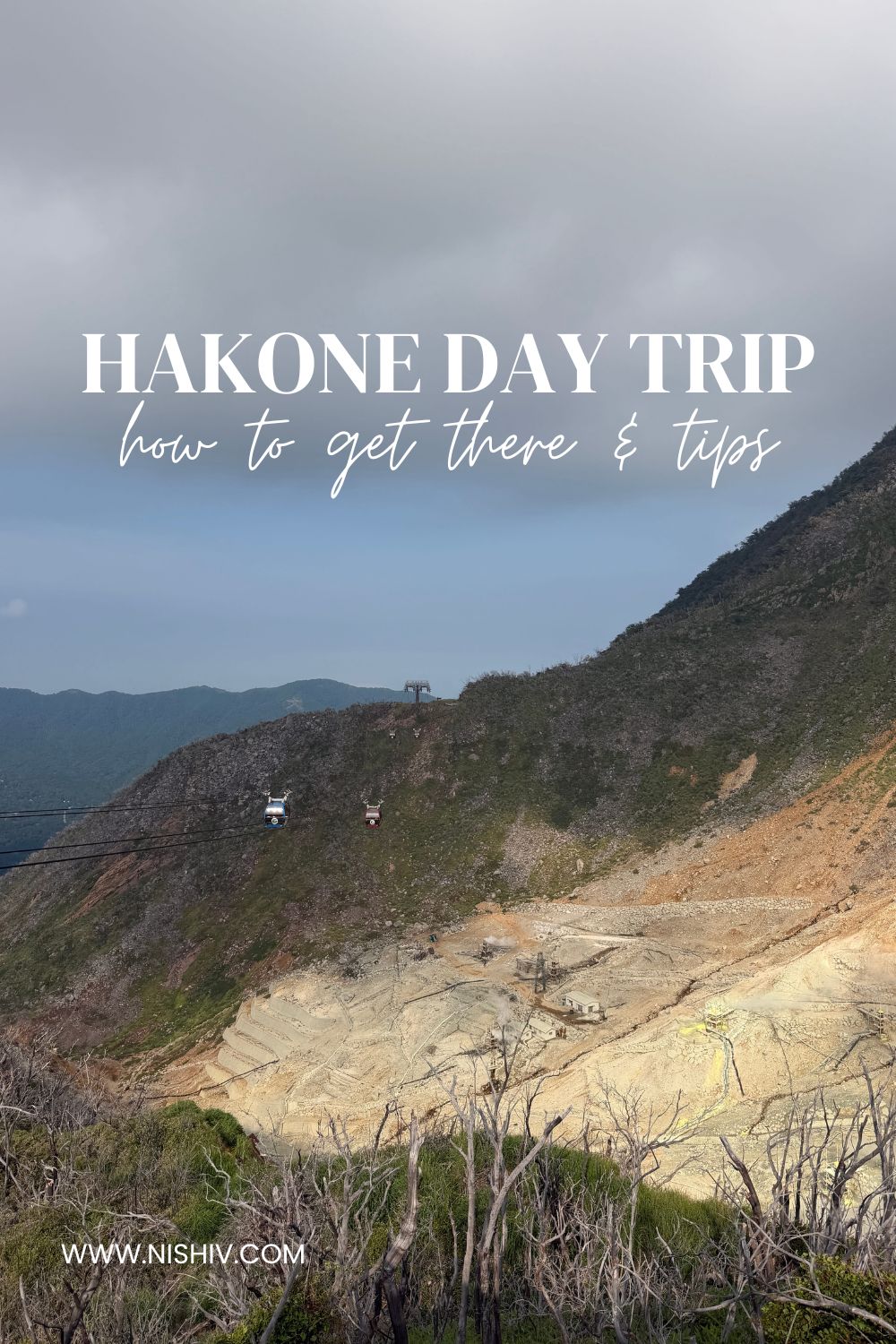
If you found this Hakone guide helpful, PIN IT!
Read more about planning a trip to Japan:
- 10 Days in Japan in July for First-Time Visitors
- 5 Days in Tokyo: A First-Timer’s Tokyo Itinerary
- Where to Stay in Tokyo for the Best First Time Experience
- Park Hotel Tokyo Review: Is This Art Hotel Worth Staying At?
- 40 Things to Do in Tokyo on Your First Trip
- My Asakusa Sumo Experience: Is It Worth Booking?
- Street Kart Tokyo Bay: Is It Worth Doing?
- Hakone Day Trip From Tokyo: Route, Tips & Mistakes to Avoid
- Renting a Grandma in Tokyo: What Happened When We Tried It
- Things to Do in Sapporo: 22 Places to Visit on Your First Trip
- 5 Days in Sapporo: A First-Timer’s Sapporo Itinerary
- Vegetarian Food in Sapporo: 5 Best Places to Eat
- Sapporo Grand Hotel Review: Why I Loved It
- Day Trip to Otaru from Sapporo: What to See and Do
Need help planning your trip from start to finish?
Check out these helpful links:
- 👉🏼 Find cheap flights
- 👉🏼 Savings on accommodation from boutique hotels to affordable resorts
- 👉🏼 The most comprehensive resource to help plan excursions on your next trip
- 👉🏼 This pass gives you free lounge access to over 1500 airport lounges
- 👉🏼 Affordable car rental options
- 👉🏼 Book land and water transport for travelling around South East Asia
- 👉🏼 Use code: NISHI9255 to get £2.50 off your first eSIM before you travel
- 👉🏼 Pay anywhere in the world, in any currency, using your debit card without fees
- 👉🏼 Travel insurance with essential medical & travel coverage at low premiums
