
Renting a Grandma in Tokyo: What Happened When We Tried It

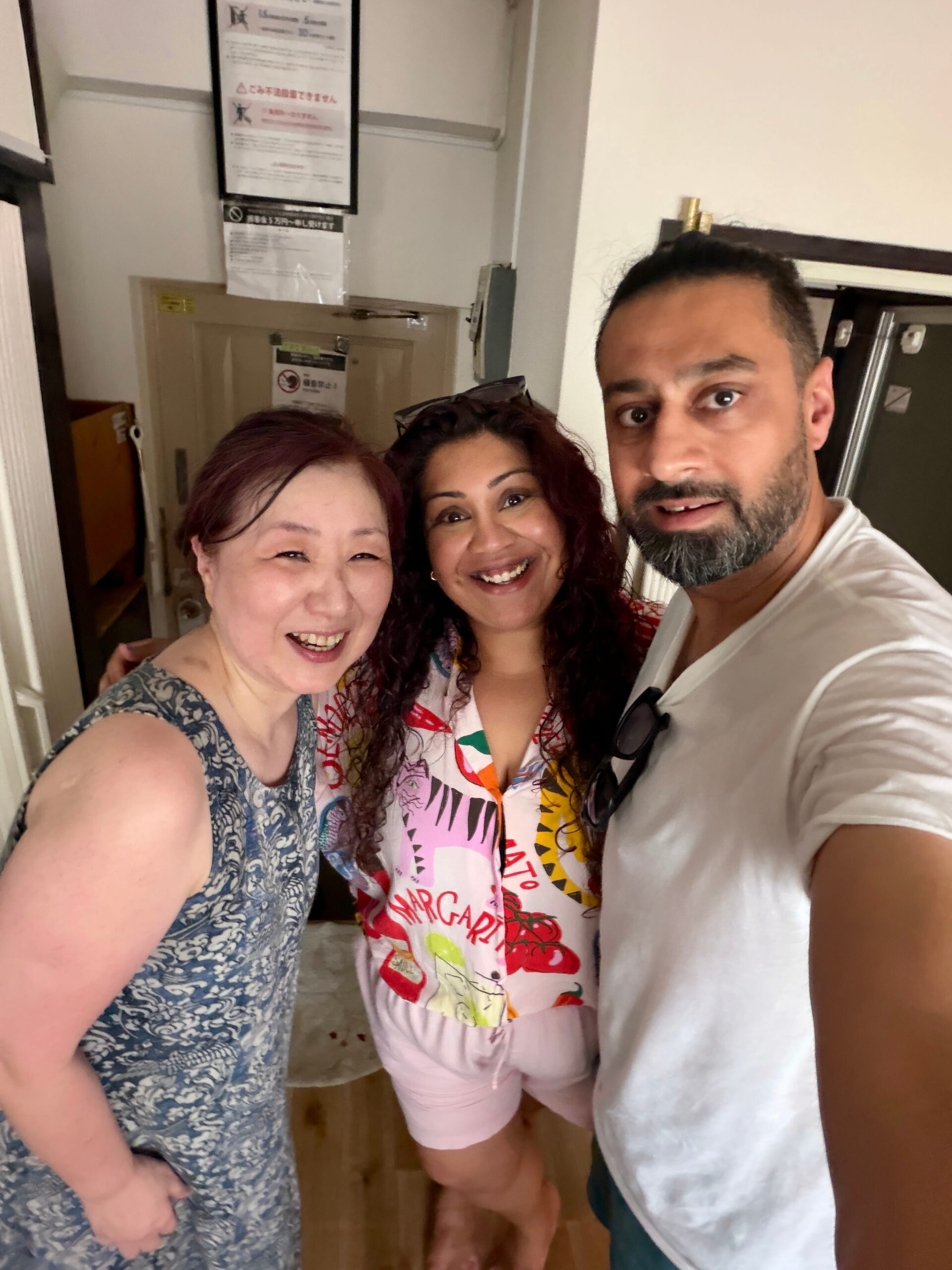
You can rent tons of things in Tokyo.
Cars. Clothes. Portable chargers. Boyfriends. Girlfriends. Grandmas.
Naturally, I had questions.
Given that Jass and I are married to each other, we weren’t going to rent a girlfriend or boyfriend. But I was intrigued by the grandma rental service option.
While looking for unusual things to do in Japan, I discovered OK Obaachan, a rental grandma service in Tokyo where you can hire a Japanese woman aged between 60 and 94 by the hour.
And apparently you can ask grandma to do almost anything.
Cook for you. Teach you something. Give you advice. Look after your children.
You can even ask her to help you break up with someone.
We didn’t do that. Obviously.
Instead, Jass and I spent two hours with our rental grandma in a kitchen in Tokyo, where she taught us how to make mochi.
Then she taught Jass how to use chopsticks.
Because somehow he’d made it across Asia with me over the course of 20 years without mastering that particular skill.
It ended up being one of the most unusual but wholesome experiences we had in Tokyo, and also one of the most personal.
So, if you’ve stumbled across the idea of renting a grandma in Tokyo and are wondering what on earth actually happens, this is what the OK Obaachan service is, how it works and what happened when we tried it ourselves.
This post may contain affiliate links which means that I may earn a small commission, at no extra cost to you, for qualifying purchases. For more information, read our disclaimer.
Can you really rent a grandma in Tokyo?
Yes.
And the service we used is called OK Obaachan.
Obaachan means grandma or grandmother in Japanese, although you’re not technically paying someone to spend two hours pretending to be your long-lost Japanese relative.
The service is run by Tokyo-based company Client Partners and allows people to hire older women for their time, knowledge and skills.
That could mean help with cooking, childcare or household tasks.
It could also mean asking for life advice, learning a new skill or simply having the support of an older woman in a situation where you might want it.
Some of the reported requests have been considerably more unusual.
Women working for OK Obaachan have apparently even been asked to help customers deal with relationship problems and break-ups.
Suddenly asking someone to make mochi with us felt positively mundane.
It was certainly one of the most unusual things we found to do in Tokyo.
I’d seen a number of videos across social media where people rent a boyfriend or girlfriend on their trips to Japan. I don’t think this is inherently a tourist activity, but it has increasingly evolved into a popular tourist experience for ‘the views’.
Being married, we weren’t interested in that.
So naturally, we explored the option of renting a grandma instead.
What is the OK Obaachan rental grandma service?
OK Obaachan is a rental grandma service in Japan operated by a company called Client Partners.
The concept initially sounds like one of those bizarre Japan stories designed specifically to make people on the internet say of course this exists in Tokyo.
But the reality is considerably less gimmicky.
You’re hiring an older woman for her time and experience.
The women can be asked to help with practical tasks, teach skills or provide support, depending on what the customer needs and what can be arranged.
And that’s what I found particularly interesting about it.
Older women have decades of knowledge and life experience. OK Obaachan essentially gives them a way to turn some of that into paid work.
We learned that locals often rent grandmas because they live far away from their families and miss their mother’s cooking. These grandmas might be paid to spend a couple of hours cooking in somebody else’s home while keeping them company.
The service also helps address urban isolation and loneliness for older people while providing extra income and a sense of purpose; ikigai for older women amid Japan’s increasingly ageing population.
Reading about this is what originally sent me down the rental-grandma rabbit hole.
Why we decided to rent a grandma in Tokyo
After a ton of research, I sent an email to Client Partners to enquire about how the process works.
I also wanted to know if it was available to book at short notice, as we’d only planned our Japan trip within 10 days of flying out, and more importantly, whether they had any English-speaking grandmas available.
This was key as neither of us speaks Japanese, and I can imagine this would have been extremely challenging for all of us otherwise.
I don’t know what I was expecting, but I was pleasantly surprised to hear back from them within a couple of days, answering all of my questions.
Unsurprisingly, it turns out that finding an English-speaking woman over the age of 60 was almost impossible, and there were no interpreters available either.
However, to my delight, they had a slightly younger employee who did speak English, so we snapped up the opportunity.
Now that I’d established that this was, in fact, a real thing, the next question was what we were actually going to do with our grandma.
We decided we wanted to learn to cook something.

More specifically, we wanted her to teach us how to make Japanese daifuku, or mochi, my favourite Asian dessert.
They came back to me offering a two-hour booking with said ‘grandma’ in a rental apartment with an equipped kitchen, but said two hours was too much time for one dish. So they suggested we learn to make three:
- Daifuku
- Isobe dango
- Mitarashi dango
I had never heard of dango, but they explained that it’s a traditional Japanese sweet dumpling made from rice flour and that it would work well alongside a mochi-making class.
So I went with it.
I liked the idea of doing something together in a personal way, rather than simply hiring somebody to show us around Tokyo.
We’d already spent plenty of time sightseeing during our trip, so this was an opportunity to have a completely different kind of experience.
We’d already done everything from street karting around Tokyo to watching sumo wrestling in Asakusa, but this felt considerably more personal.
Instead of another observation deck, shrine or famous neighbourhood, we were going to spend two hours in a kitchen with a Japanese grandma.
We fitted the experience into our 5-day Tokyo itinerary.
Perfectly normal holiday behaviour if you ask me.
How do you book OK Obaachan?
We booked our experience directly through Client Partners by email.
This isn’t a conventional tour company, so don’t expect to find a list of experiences you can simply choose and book online.
Each booking is tailored to the customer’s requirements, based on a minimum booking of two hours.
I explained that we were visiting Tokyo, the dates we were available and that we needed someone who spoke English. We then went back and forth over email to arrange the rest.
Once we’d agreed on making daifuku and dango, they organised the rental apartment, giving me a choice of two locations, and of course the grandma we’d be hiring.
The cost of the rental apartment and grandma was included in their fee, with the ingredients charged separately. They then sent me an invoice via PayPal.
Our two options were:
2-hour booking: JPY 28,700 including tax, plus ¥3,000 for ingredients
3-hour booking: JPY 38,000 including tax, plus ¥3,000 for ingredients
We secured the two-hour slot with full payment and were sent a very detailed email with the address.
If you’ve been to Japan and tried to locate anything on Google Maps, you’ll know just how challenging this can be, so I was grateful for the information.
We arrived 30 minutes early and still managed to get very, very lost!
Had it not been for a super helpful passer-by who stood with us for a full 20 minutes trying to locate the building, we would never have found it.
Thankfully, he was able to phone the company for us, speak to them in Japanese and us in English, and even went out of his way to walk around the building trying to locate the apartment.
Even though we were on the right street, addresses can be very difficult to decipher in Japan.
Considering we’d planned the whole thing at such short notice, the booking process itself was surprisingly straightforward.
Communication was effortless, and I was even more impressed that they managed to find a rental apartment at such short notice too.
The main thing I’d recommend if you’re travelling from overseas is contacting them as early as possible, particularly if you need somebody who speaks English.
As we discovered, your options can be considerably more limited.
I’d also approach them with an idea of what you’d actually like to do with your grandma rather than expecting to choose from a fixed list of experiences.
For current availability, requirements and prices, I’d contact Client Partners directly before booking rather than relying on information from articles online.
When you first contact them, I’d include your dates, how many people are booking, whether you need somebody who speaks English and an idea of what you’d like to do with your grandma.
Meeting our rental grandma
We arranged to meet our grandma, Megumi-san, at an apartment in Yoyogi.

It turned out that she’d struggled to locate the apartment too, so we all arrived slightly flustered and a bit late.
I’m glad it wasn’t just us!
Walking in together was probably the point where the slightly ridiculous concept of we’ve rented a grandma stopped being an internet novelty and became an actual interaction with another person.

The apartment was on the fourth floor of a building with no lift and was just as compact as I’d imagined an apartment in Japan might be.
In true Japanese fashion, she instructed us to remove our shoes as soon as we set foot inside, before busying herself getting familiar with the kitchen.
The kitchen was tiny and extremely dated.
According to our grandma, the entire place was very old-fashioned.
I don’t think she was impressed.

It was 37°C and we’d been told the kitchen had air conditioning, but frustratingly, it wasn’t working.
This became irritating very quickly while the three of us were profusely sweating away in a tiny shoebox.
July in Japan had already been brutally hot. We’d experienced the same thing during our day trip to Hakone, where even being up in the mountains only made things marginally cooler.
Apparently there would be no escaping it in this kitchen either.

It felt awkward initially as she unpacked the shopping bags in silence and searched for all the equipment.
She laid the ingredients out on the dining table and got us to work immediately. Jass carefully measured the flour into separate bowls while I coated strawberries in red bean paste.
A painfully difficult task when the paste keeps sliding off the smooth strawberries, let me tell you.

We got prepping in companionable silence until I realised this was our small window of opportunity to interact with a local.
I asked if she made mochi at home and wasn’t surprised to hear the answer was no. I’ve seen videos online of people pounding mochi in Kyoto, and wondered how we’d be doing that.
What did surprise me was when she told me she’d found the recipe using AI!
I realised I could have quite easily done this myself at home with the right ingredients, but I wasn’t annoyed about it.
If anything, I felt a little bad that she was winging it and that the company hadn’t explained that this wasn’t something she regularly made at home. According to Megumi-san, most people simply buy mochi or daifuku when they want to eat it.
After attempting to make it myself, I completely understand why.
Regardless, renting a grandma in Japan for me was always more about the overall experience than learning how to make mochi myself.
Making mochi with our Japanese grandma
So Megumi-san taught us how to make mochi according to the instructions on her iPad.
Not quite the ancient family recipe I’d perhaps imagined.
She’d purchased all the ingredients required and was incredibly patient with us, though she must have quickly realised we were both terrible at doing seemingly basic tasks such as mixing the starchy flour for mochi.
The mixture is incredibly starchy, sticky and hard to work with.
Let me tell you, this was so much harder than it looks.
Especially in a sweatbox at 37°C.
We had to keep pausing to refrigerate the mochi because it was melting on the table in front of us.

Jass and I were set up around the dining table while she was busy in the kitchen, and by the time we’d finished the mochi, we realised she’d made the dango herself because we were running out of time.
So much for learning three dishes.
There were two types.
The first was isobe dango, a savoury version dipped into sweetened soy sauce and wrapped in nori.
I really didn’t like this one.
She’d also made mitarashi dango, a slightly sweeter version with a glossy, caramel-like coating.
This one was marginally more palatable.
The mochi, however, was the star of the show.
It looked like a hot mess, thanks in part to the heat.
Let’s not mention my non-existent skills.

However, it tasted sensational.
I’d eaten mochi before.
I’d never made it in a rented kitchen in Tokyo under the supervision of a grandma I’d hired by the hour.
Slightly different experience.
Red bean mochi is my favourite flavour and with a deliciously crisp strawberry inside, it was perfect.
You just had to close your eyes to eat it!
I couldn’t tell you exactly which ingredients we used as it all felt a bit rushed between arriving late, spending a lot of time trying to figure out how to cool the apartment down and then having to cook in the heat.
I think I’ll stick to buying mochi in the future.

And then grandma taught Jass how to use chopsticks
Making mochi and dango was what we’d actually planned.
The chopstick lesson was not.

We sat around the table with Megumi-san listening to her stories of a summer she spent living in Oxford 40 years ago.
This explained why her English was so good, and considering how worried I’d been about the language barrier when booking the experience, we got incredibly lucky.
We were discussing the differences between Japanese and English culture when suddenly I remembered an important question I had for her.
I had been desperate for Jass to learn how to use chopsticks for years, unable to keep watching him hacking away at sushi with a fork.
After many failed attempts and him forever asking for a fork, I had almost given up.
I suddenly thought, he needs a better teacher than me, and what better than a real-life Japanese grandma?
She found it hilarious when I asked her, and even more so when Jass pulled out two pairs of chopsticks he’d picked up at a convenience store on the way, ready to learn.
We laughed our way through the tutorial each time the dango slipped out of the chopsticks.
She showed him the correct technique and kept repositioning his hands, but to no avail.
It was looking like he had no hope.
But to be fair, dango is very slippery and even I would have struggled.
He managed to eat one and called it a day. I was convinced it was probably a fluke.

The following day, he surprised me by eating noodles without asking for a fork, so I guess it had worked!
He hasn’t looked back since and I couldn’t be happier.
Honestly, eating sushi with a fork is criminal.
Either way, I hadn’t realised a complimentary chopstick lesson was included in the OK Obaachan experience.
Excellent value for money.
How much does it cost to rent a grandma in Tokyo?
Rather than give you a price that could be completely wrong by the time you read this, I’d check the current rates directly with Client Partners before booking.
When we booked, our two-hour experience cost JPY 31,700 which worked out at around £150 at the time.
That included our grandma’s time, her transport, ingredients and the rental apartment.
The total cost will depend on exactly what you’re asking your grandma to do and any additional expenses involved in arranging the experience.
For us, two hours felt like the perfect amount of time.
It flew by, and to be honest, I would have been happy to skip the dango altogether.
We had enough time to get to know Megumi-san, learn how to make mochi and, most importantly, for Jass to grasp the concept of eating with chopsticks.
I wasn’t impressed with the rental apartment not having functioning air conditioning.
This was something I’d checked before booking because I know Tokyo in July is no joke, and aside from us, Megumi-san was also struggling in the heat.
Not only did she have to teach in an extremely warm kitchen in unfamiliar surroundings, she had to follow a recipe she’d never made before while speaking English with two strangers.
She told us speaking English doesn’t come naturally any more as she has no need to use it in Japan.
She did very well.
For us, it was about the overall experience itself rather than actually learning a recipe for mochi.
Don’t assume the advertised hourly rate will necessarily be the entire cost of your experience. The best thing to do is email Client Partners with your enquiry and ask for a quote based on what you want to do.
What can you ask a rental grandma to do in Japan?
The slightly strange thing about OK Obaachan is that there isn’t one obvious reason to book it.
This isn’t a conventional Tokyo tour where everyone follows the same itinerary.
The whole point is that different customers need different things.
We learned that uses of the rental grandma service in Japan have included practical jobs such as cooking, cleaning and childcare, as well as providing advice or support in more personal situations.
And yes, that apparently includes relationship problems.
For travellers, I think the interesting part is the possibility of asking someone to share a skill or experience with you rather than simply paying for another conventional tour.
I also think it’s a lovely way for older people to share their skills and experience, and she enjoyed meeting us as much as we enjoyed our time with her.
That was also what we enjoyed about our Asakusa sumo experience. Yes, this was touristy, but we actually got to learn something about sumo rather than simply watching it from the sidelines.
Renting a grandma felt even more personal because there was no set experience at all.
For us, that meant mochi.
For somebody else, it could be something completely different.
Is renting a grandma in Japan ethical?
I’ll admit that the phrase rent a grandma sounds a little questionable when you first hear it.
It makes the whole thing sound considerably stranger than it actually is.
You’re not hiring somebody to pretend to love you for two hours.
You’re paying an older woman for her time, knowledge and skills.
That distinction became much clearer to me once Megumi-san explained that there is no such thing as the traditional concept of retirement in Japan.
Older people in Japan work well into their 90s due to a mix of financial necessity, cultural values and a desire to stay healthy and connected.
The service also flips one fairly depressing assumption about ageing on its head.
Rather than treating older women as though their usefulness somehow decreases with age, OK Obaachan is built around the opposite idea.
Their decades of skills and life experience have value.
Literal financial value, in this case.

Megumi-san loved meeting new people, though this was her first time working with tourists.
She works for Client Partners part-time and spends the rest of her time working as a psychologist.
She likes the contrast between her two professions and being able to help people in different ways through both.
For me, meeting her made the whole thing feel considerably less like renting a grandma and much more like paying somebody for a couple of hours of their time and experience.
Which, ultimately, is exactly what it is.
Is OK Obaachan for tourists?
No.
OK Obaachan wasn’t created purely as an unusual activity for people visiting Tokyo.
The service is predominantly used by people in Japan who want the help, knowledge or support of an older woman for all sorts of reasons.
We just happened to use it in a very tourist-specific way.
That’s worth understanding before booking.
You’re not buying a pre-packaged ‘Japanese Grandma Experience™’.
We approached the service with something we wanted to learn and arranged an experience around that.
For me, that’s part of what made it so interesting.
Would I recommend renting a grandma in Tokyo?
For us, it was absolutely worth it.
It was certainly one of the most unusual experiences we had during our time in Tokyo.
But the novelty of being able to say we rented a grandma in Japan isn’t really the part I remember most.

I loved learning more about Japanese culture from a local while making my favourite dessert.
That’s what separates it from simply booking another attraction.
You get to decide what you want to do with your rental grandma.
If you’re looking for something a little different from temples, observation decks and enormous crossings, renting a grandma in Tokyo certainly qualifies.
Whether you’re travelling to Japan as a couple or solo, and whether it’s your first time in the country or not, I’d wholeheartedly recommend the experience.
If you’re deciding how much time to allow in the city, this is exactly the sort of experience I’d save for a longer stay. My 5-day Tokyo itinerary gave us enough time to do the major sights without every day being filled exclusively with them.
You get to meet somebody you would otherwise never have met, learn something directly from her and create an experience around what actually interests you.
In our case, we came away knowing how to make mochi and considerably more about Japanese culture.
And Jass came away knowing how to use chopsticks.
I’d call that a productive two hours.
If you’re looking for more ideas, I’ve put together 40 things to do in Tokyo from the same trip.
If you found this guide on renting a grandma in Japan helpful, PIN IT!


Read more about planning a trip to Japan:
- 10 Days in Japan in July for First-Time Visitors
- 5 Days in Tokyo: A First-Timer’s Tokyo Itinerary
- Where to Stay in Tokyo for the Best First Time Experience
- Park Hotel Tokyo Review: Is This Art Hotel Worth Staying At?
- 40 Things to Do in Tokyo on Your First Trip
- My Asakusa Sumo Experience: Is It Worth Booking?
- Street Kart Tokyo Bay: Is It Worth Doing?
- Hakone Day Trip From Tokyo: Route, Tips & Mistakes to Avoid
- Renting a Grandma in Tokyo: What Happened When We Tried It
Need help planning your trip from start to finish?
Check out these helpful links:
- 👉🏼 Find cheap flights
- 👉🏼 Savings on accommodation from boutique hotels to affordable resorts
- 👉🏼 The most comprehensive resource to help plan excursions on your next trip
- 👉🏼 This pass gives you free lounge access to over 1500 airport lounges
- 👉🏼 Affordable car rental options
- 👉🏼 Book land and water transport for travelling around South East Asia
- 👉🏼 Use an eSIM to prepare your phone for international travel before leaving
- 👉🏼 Pay anywhere in the world, in any currency, using your debit card without fees
- 👉🏼 Travel insurance with essential medical & travel coverage at low premiums
